
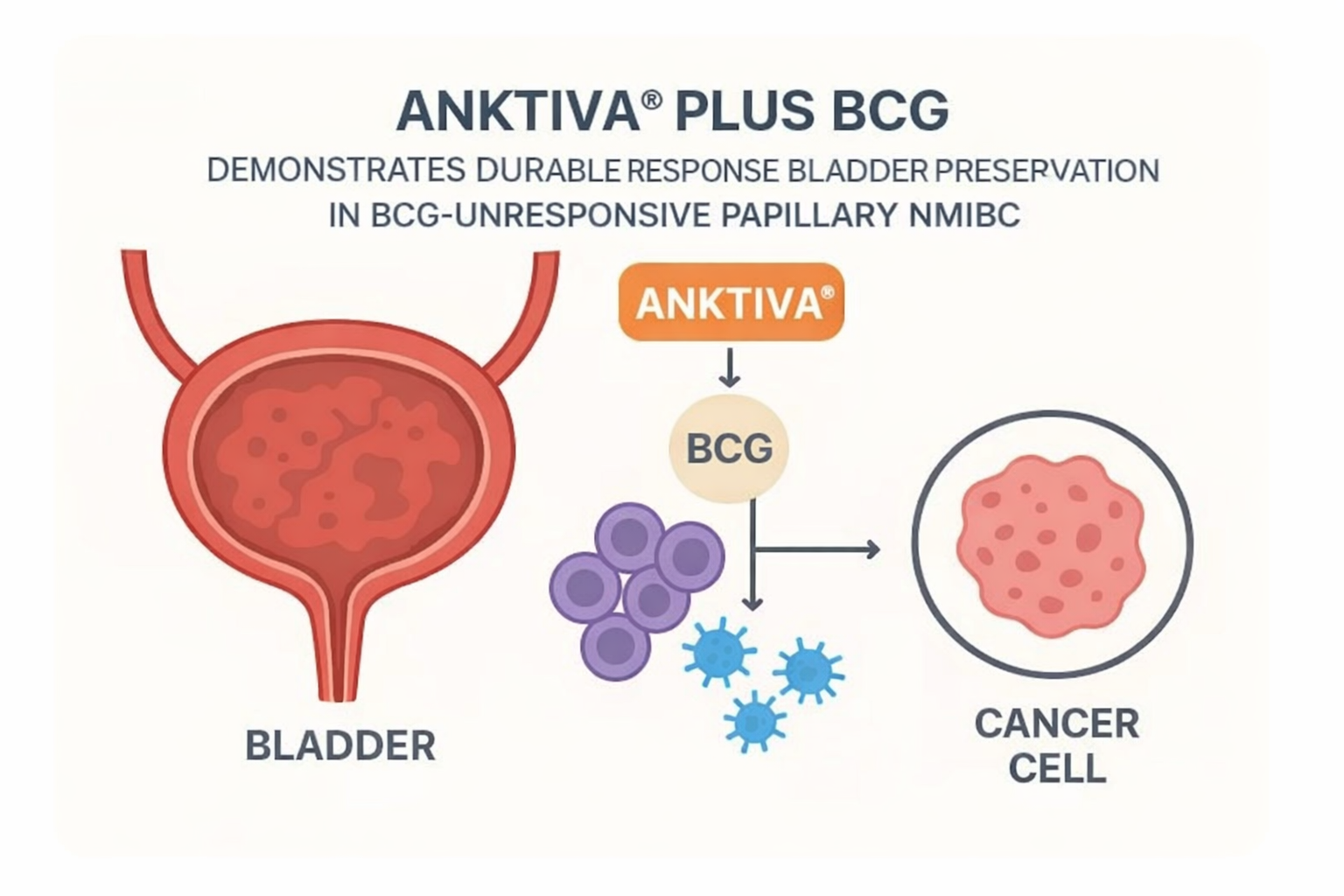
This article reviews long-term outcomes of the IL-15 receptor agonist nogapendekin alfa inbakicept (NAI) combined with intravesical bacillus Calmette-Guérin (BCG) in patients with BCG-unresponsive, high-grade papillary-only non–muscle-invasive bladder cancer (NMIBC) from cohort B of the QUILT-3.032 study. At 36 months, the regimen demonstrated durable disease control, high progression-free survival, and substantial cystectomy avoidance with a favorable safety profile. These findings support NAI + BCG as a promising bladder-sparing immunotherapy strategy for a population with limited treatment options. More recent peer-reviewed data further strengthen these findings by demonstrating high bladder cancer–specific survival with extended follow-up, addressing a key clinical concern regarding bladder-sparing strategies in BCG-unresponsive disease.
Clinical Takeaway
In patients with BCG-unresponsive papillary-only NMIBC, NAI plus BCG produced durable disease-free and progression-free survival through 36 months while allowing the majority of patients to avoid cystectomy. Disease-free survival declined gradually over time but remained clinically meaningful, progression events were uncommon, and bladder preservation rates exceeded 80% at 3 years. Toxicity was predominantly low grade, with few severe adverse events and no grade 4–5 toxicities reported, reinforcing the feasibility of long-term bladder-sparing treatment; median disease-specific survival and median time to cystectomy were not reached. Importantly, bladder cancer–specific survival was 96% at 36 months, with median disease-specific survival not reached, supporting the oncologic safety of prolonged bladder preservation in appropriately selected patients.
Drug Profile & Mechanism
- Agent: Nogapendekin alfa inbakicept (NAI)
- Class: IL-15 receptor α–dependent lymphocyte-stimulating agent
- Mechanism of Action: Enhances activation and expansion of NK cells and CD8+ T cells, amplifying immune-mediated tumor cell killing when administered with BCG
- Therapeutic Rationale: Augments BCG-induced antitumor immunity to overcome BCG resistance while preserving bladder function
- Route of Administration: Intravesical (in combination with BCG)
QUILT-3.032 Study Design (NCT03022825)
- Design: open-label, multicenter clinical study with extended follow-up
- Population: Patients with BCG-unresponsive, high-grade papillary-only NMIBC (no carcinoma in situ)
- Treatment Regimen: NAI administered with standard intravesical BCG
- Follow-up Duration: Outcomes reported through 36 months
- Primary/Key Endpoints: Disease-free survival (DFS), progression-free survival (PFS), cystectomy-free survival
Efficacy Outcomes
- Disease-Free Survival (DFS):
- 12 months: 58.2%
- 24 months: 52.1%
- 36 months: 38.2%
- Median DFS: 25.3 months
- Progression-Free Survival (PFS):
- 12 months: 94.9%
- 24 months: 88.7%
- 36 months: 83.1%
- Median PFS: Not reached
- Cystectomy-Free Survival:
- 12 months: 92.2%
- 24 months: 87.9%
- 36 months: 81.8%
- Median Time to Cystectomy: Not reached
- Disease-Specific Survival (DSS):
- 12 months: 98.7%
- 24 months: 96.0%
- 36 months: 96.0%
- Median DSS: Not reached
- Overall Survival (OS):
- 12 months: 98.7%
- 24 months: 94.7%
- 36 months: 91.7%
- Key Takeaway:
- NAI plus BCG demonstrates durable long-term disease control, high progression-free survival, and substantial cystectomy avoidance, with median DFS, DSS, and time to cystectomy not yet reached, highlighting the durability and safety of bladder-sparing therapy in this high-risk population.
Safety
- Overall Tolerability: Generally well tolerated
- Adverse Events:
- Grade 1–2: ~61%
- Grade 3: ~3%
- Grade 4–5: None reported
Key Clinical Implications
✔ Demonstrates durable bladder preservation in a high-risk, treatment-refractory population
✔ Provides a potential alternative to early radical cystectomy
✔ Supports continued development of immune-enhancing strategies in NMIBC
✔ Relevant for oncologists managing patients seeking bladder-sparing options after BCG failure
✔ Confirms high bladder cancer–specific survival (96% at 3 years), supporting the oncologic safety of bladder preservation
✔ Addresses a key concern regarding delayed cystectomy by demonstrating low bladder cancer–related mortality with extended follow-up
Sources:
- Chang, S. S., Chamie, K., Kramolowsky, E., Gonzalgo, M. L., Agarwal, P. K., Bassett, J. C., … Soon-Shiong, P. (2026). Prolonged Progression-Free Survival, Disease-Free Survival, and Cystectomy Avoidance With IL-15 Receptor Lymphocyte–Stimulating Agent NAI Plus Bacillus Calmette-Guérin in Bacillus Calmette-Guérin–Unresponsive Papillary-Only Nonmuscle-Invasive Bladder Cancer. Journal of Urology, 215(1), 44–56. https://doi.org/10.1097/JU.0000000000004782 (Original work published January 1, 2026)
- ImmunityBio, Inc. (2025). QUILT-3.032: Nogapendekin alfa inbakicept (N-803) plus Bacillus Calmette-Guérin in patients with BCG-unresponsive high-grade non-muscle-invasive bladder cancer (ClinicalTrials.gov Identifier: NCT03022825). U.S. National Library of Medicine. Retrieved from https://clinicaltrials.gov/study/NCT03022825
- U.S. Food and Drug Administration. (2024, April 22). FDA approves nogapendekin alfa inbakicept-pmln with BCG for BCG-unresponsive non-muscle-invasive bladder cancer. Retrieved from https://www.fda.gov/drugs/resources-information-approved-drugs/fda-approves-nogapendekin-alfa-inbakicept-pmln-bcg-unresponsive-non-muscle-invasive-bladder-cancer