

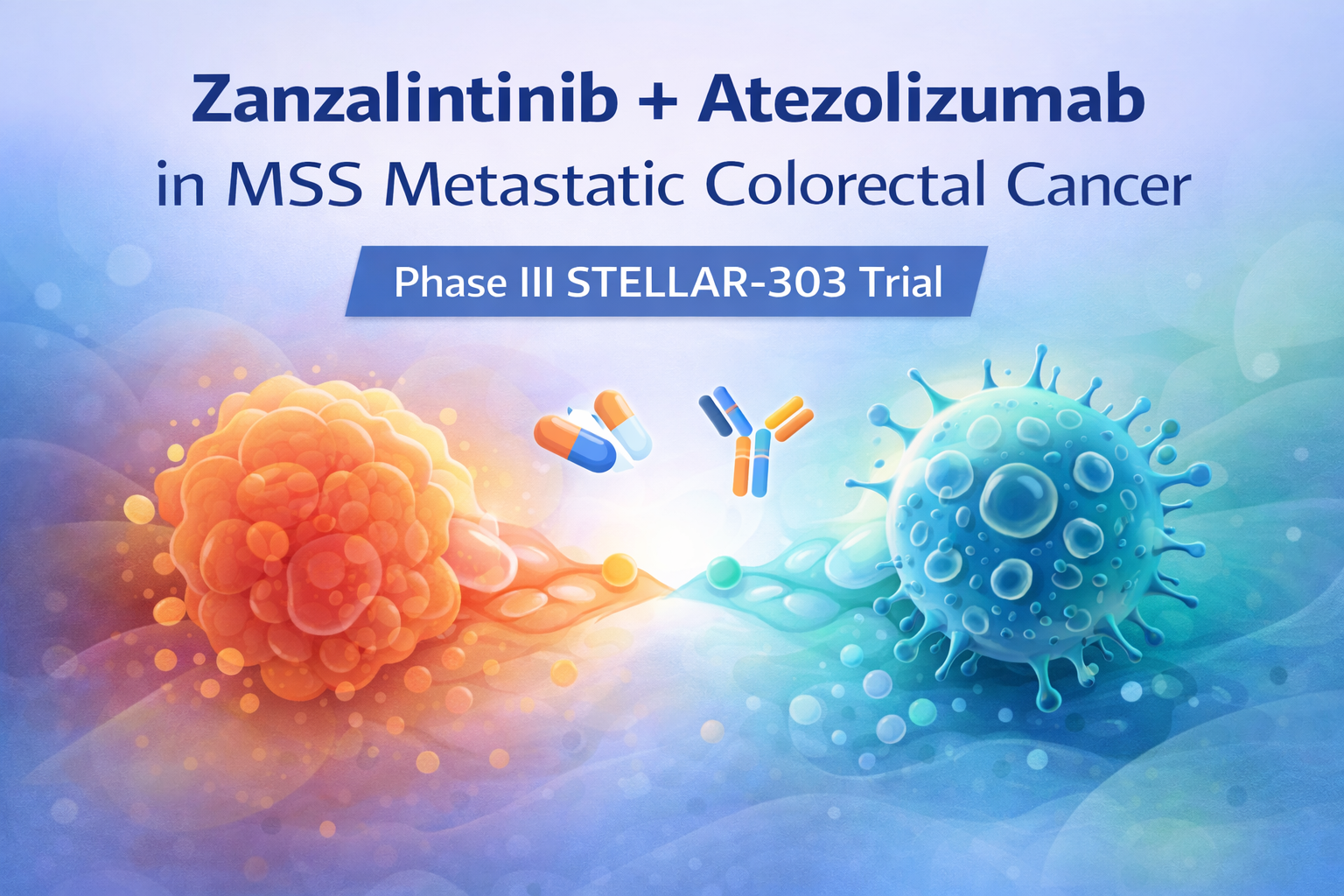

Patients with refractory metastatic colorectal cancer (mCRC) and microsatellite-stable (MSS) disease have limited treatment options and historically derive minimal benefit from immunotherapy. In the phase III STELLAR-303 trial, zanzalintinib plus atezolizumab significantly improved overall survival (OS) and progression-free survival (PFS) compared with regorafenib in previously treated MSS mCRC, including patients with and without liver metastases. These findings suggest a potential new immunotherapy-based option for a population with high a unmet need.
Clinical Takeaway
STELLAR-303 demonstrates that combining the multitargeted tyrosine kinase inhibitor (TKI) zanzalintinib with the programmed death-ligand 1 (PD-L1) inhibitor atezolizumab can extend survival beyond current standard therapy in refractory MSS mCRC, a setting where immune checkpoint inhibitors alone have been ineffective. OS and PFS benefits were consistent across key subgroups, including patients with liver metastases, supporting the concept that immunomodulatory TKIs may help overcome resistance to immunotherapy in MSS disease. Although the absolute magnitude of benefit is modest, this regimen represents a meaningful advance and may influence later-line treatment strategies pending biomarker refinement and regulatory review.
Drug Profile & Mechanism
- Agent: zanzalintinib + atezolizumab
- Class: Small-molecular multitargeted TKI + monoclonal antibody immune checkpoint inhibitor
- Mechanism of action:
- zanzalintinib inhibits multiple kinases involved in tumor angiogenesis and immune suppression, promoting a more pro-inflammatory tumor environment
- atezolizumab blocks PD-L1, restoring antitumor T-cell activity
- Route of administration:
- zanzalintinib: Oral
- atezolizumab: Intravenous
- Target population: Adults with previously treated, refractory metastatic colorectal cancer with MSS disease
STELLAR-303 Study Design (NCT05425940)
- Study Type: Global, randomized, open-label, phase III trial
- Population: 901 patients with refractory MSS mCRC
- Comparator: regorafenib (Stivarga) – current standard of care
- Treatment Regimen: zanzalintinib + atezolizumab vs single-agent regorafenib
- Follow Up Duration: Median follow-up of 18.0 months (IQR, 14.6–21.5) for the primary OS analysis
- Key Endpoints:
- Dual primary endpoints:
- OS in the intent-to-treat population
- OS in patients without active liver metastases
- Secondary endpoints:
- PFS and prespecified subgroup analyses
- Dual primary endpoints:
Efficacy Outcomes
- Primary Endpoint Results:
- Median OS:
- zanzalintinib + atezolizumab: 10.9 months
- regorafenib: 9.4 months
- Median OS:
- Key Secondary Endpoint Results:
- Median PFS:
- zanzalintinib + atezolizumab: 3.7 months
- regorafenib: 2.0 months
- Median PFS:
Regulatory Milestones
- Approval Date: Not yet approved for this indication (as of 2025)
- Regulatory Pathway:
- U.S. New Drug Application (NDA) planned based on positive phase III STELLAR-303 OS data
- Filing expected for zanzalintinib in combination with atezolizumab in previously treated MSS mCRC
- Approval Review:
- Review status not yet disclosed
- No formal announcements regarding priority or accelerated review
- Regulatory submissions supported by peer-reviewed publication of STELLAR-303 results in The Lancet
Safety
- Overall AE Burden: Treatment-related adverse events (TRAEs) of any grade were common in both groups, consistent with heavily pretreated mCRC populations.
- Grade ≥3 Events:
- Zanzalintinib–atezolizumab: 268 of 446 patients (60%)
- Regorafenib: 161 of 434 patients (37%)
- Treatment-related deaths:
- Zanzalintinib–atezolizumab: 5 patients (1%)
- Regorafenib: 1 patient (<1%)
- Notable toxicity patterns:
- Higher rates of severe adverse events were observed with the combination compared with regorafenib alone.
- Overall, the safety profile was consistent with known toxicities of multitargeted TKIs and PD-L1 inhibitors and was considered manageable in this setting.
Key Clinical Implications
✔ May challenge regorafenib monotherapy as the default later-line option in MSS mCRC
✔ Benefit observed regardless of liver metastases, though biomarker-driven refinement is needed
✔ Most appropriate for heavily pretreated patients with preserved performance status
✔ Introduces a novel immunotherapy-based approach in a population historically resistant to ICIs
✔ Oral plus IV regimen aligns with real-world oncology practice patterns
Bottom Line
The STELLAR-303 trial provides the first phase III evidence that an immunotherapy-based combination can improve survival in refractory MSS metastatic colorectal cancer. While benefits are modest, zanzalintinib plus atezolizumab represents a meaningful step forward and a potential new later-line treatment option pending regulatory approval.
Sources:
- Hecht, J. R., Park, Y. S., Tabernero, J., Lee, M. A., Lee, S., Virgili, A. C., Van den Eynde, M., Fontana, E., Fakih, M., Asghari, G., So, J., Stein, A., Dubreuil, O., Bodnar, L., He, C. S., Wang, G., Smith, R., Eng, C., Saeed, A., & STELLAR-303 Study Investigators. (2025). Zanzalintinib plus atezolizumab versus regorafenib in refractory colorectal cancer (STELLAR-303): A randomised, open-label, phase 3 trial. The Lancet, 406(10517), 2360–2370. https://doi.org/10.1016/S0140-6736(25)02025-2
- National Library of Medicine. (n.d.). Study of XL092 (zanzalintinib) in combination with atezolizumab versus regorafenib in previously treated metastatic colorectal cancer (STELLAR-303). ClinicalTrials.gov Identifier: NCT05425940. Retrieved from https://www.clinicaltrials.gov/study/NCT05425940
- Saeed, A., Elez, E., & ESMO Daily Reporter. (2025, October 20). Zanzalintinib plus atezolizumab shows activity in metastatic colorectal cancer with microsatellite-stable disease. ESMO Congress 2025 Daily Reporter. Retrieved from https://dailyreporter.esmo.org/esmo-congress-2025/gastrointestinal-cancers/zanzalintinib-plus-atezolizumab-shows-activity-in-metastatic-colorectal-cancer-with-microsatellite-stable-disease