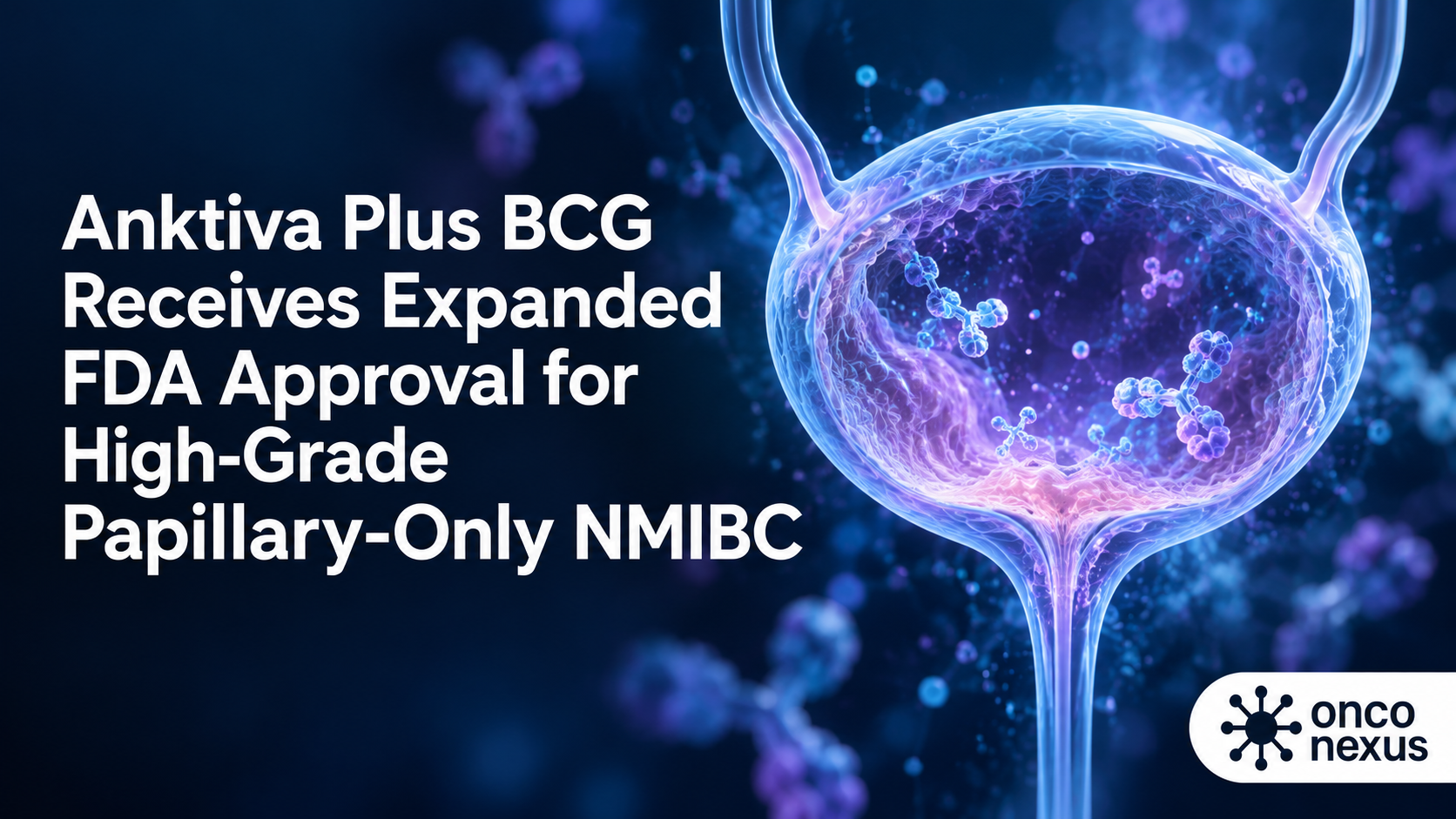
The U.S. Food and Drug Administration on October 14, 2026, approved an expanded indication for nogapendekin alfa inbakicept-pmln (Anktiva, ImmunityBio) in combination with Bacillus Calmette-Guérin (BCG) to include adults with BCG-unresponsive non-muscle invasive bladder cancer (NMIBC) harboring high-grade papillary-only tumors. The action revises the drug’s prior indication, which had been limited to BCG-unresponsive NMIBC with carcinoma in situ (CIS) with or without papillary tumors.
Rather than requiring a new prospective trial in the papillary-only population, the FDA based its decision on an extrapolation from efficacy data already established in patients with CIS-containing disease, concluding that the overlapping clinical and pathological features of high-grade papillary and CIS tumors supported extension of the prior findings to this histologic subset.
Key finding
The FDA expanded the Anktiva plus BCG indication to include BCG-unresponsive, high-grade papillary-only NMIBC by extrapolating established efficacy in CIS-containing disease. QUILT-3.032 also prospectively evaluated papillary-only disease in Cohort B, with published follow-up results; however, the FDA’s approval announcement cited extrapolation from Cohort A as the basis for the expansion.
Study Design
| Trial | QUILT-3.032 (NCT03022825), Cohort A; single-arm, multicenter |
|---|---|
| Population | 77 adults with BCG-unresponsive, high-risk NMIBC with CIS with or without Ta/T1 papillary disease following transurethral resection |
| Treatment | Nogapendekin alfa inbakicept-pmln 400 mcg intravesically with BCG weekly for 6-week induction, followed by maintenance instillations for up to 37 months |
| Primary endpoint | Complete response (CR) rate assessed by cystoscopy, urine cytology, and biopsy |
| Key secondary endpoints | Duration of response (DoR) |
QUILT-3.032 included a dedicated prospective cohort of patients with BCG-unresponsive, high-grade papillary-only NMIBC (Cohort B), for which 36-month follow-up outcomes have been published. The FDA’s approval announcement focused on established efficacy in the CIS-containing population of Cohort A and the scientific rationale for extrapolating those findings to papillary-only disease.
Results and Safety
In Cohort A of QUILT-3.032, the CR rate was 62% (95% CI: 51–73) among the 77 patients with CIS-containing disease. Among patients who achieved a CR, 58% maintained their response for at least 12 months and 40% for at least 24 months. Although outcomes from the papillary-only Cohort B have been published, the FDA announcement did not summarize those findings and instead described extrapolation from Cohort A as the basis for the expanded indication.
The most common adverse reactions occurring in at least 15% of patients, including laboratory abnormalities, were increased creatinine, dysuria, hematuria, urinary frequency, micturition urgency, urinary tract infection, increased potassium, musculoskeletal pain, chills, and pyrexia. The prescribing information carries a warning that delaying cystectomy in favor of continued drug therapy can lead to metastatic bladder cancer, which can be lethal.
Clinical Context
Patients with BCG-unresponsive NMIBC represent a high-risk population with limited treatment options outside of radical cystectomy. The label expansion broadens eligibility for nogapendekin alfa inbakicept-pmln plus BCG to include individuals whose tumors are exclusively high-grade papillary in architecture, a subset previously excluded from the approved indication. The FDA noted that high-grade papillary and CIS tumors frequently coexist, can be pathologically difficult to distinguish, and carry similarly elevated risks of recurrence and progression in the BCG-unresponsive setting, forming the scientific basis for extrapolation.
The expansion reflects the FDA’s conclusion that overlapping clinical and biological features support extrapolating efficacy from CIS-containing disease to high-grade papillary-only NMIBC. Prospective papillary-only data are available from QUILT-3.032 Cohort B, although its single-arm design limits comparative efficacy conclusions. The FDA indicated it is working to finalize guidance addressing this extrapolation approach, which may inform future drug development in BCG-unresponsive NMIBC.
Sources
- U.S. Food and Drug Administration. “FDA Approves Expanded Indication: Nogapendekin Alfa Inbakicept-pmln + BCG for BCG-Unresponsive Non-Muscle Invasive Bladder Cancer.” Regulatory approval announcement. October 14, 2026. View source.