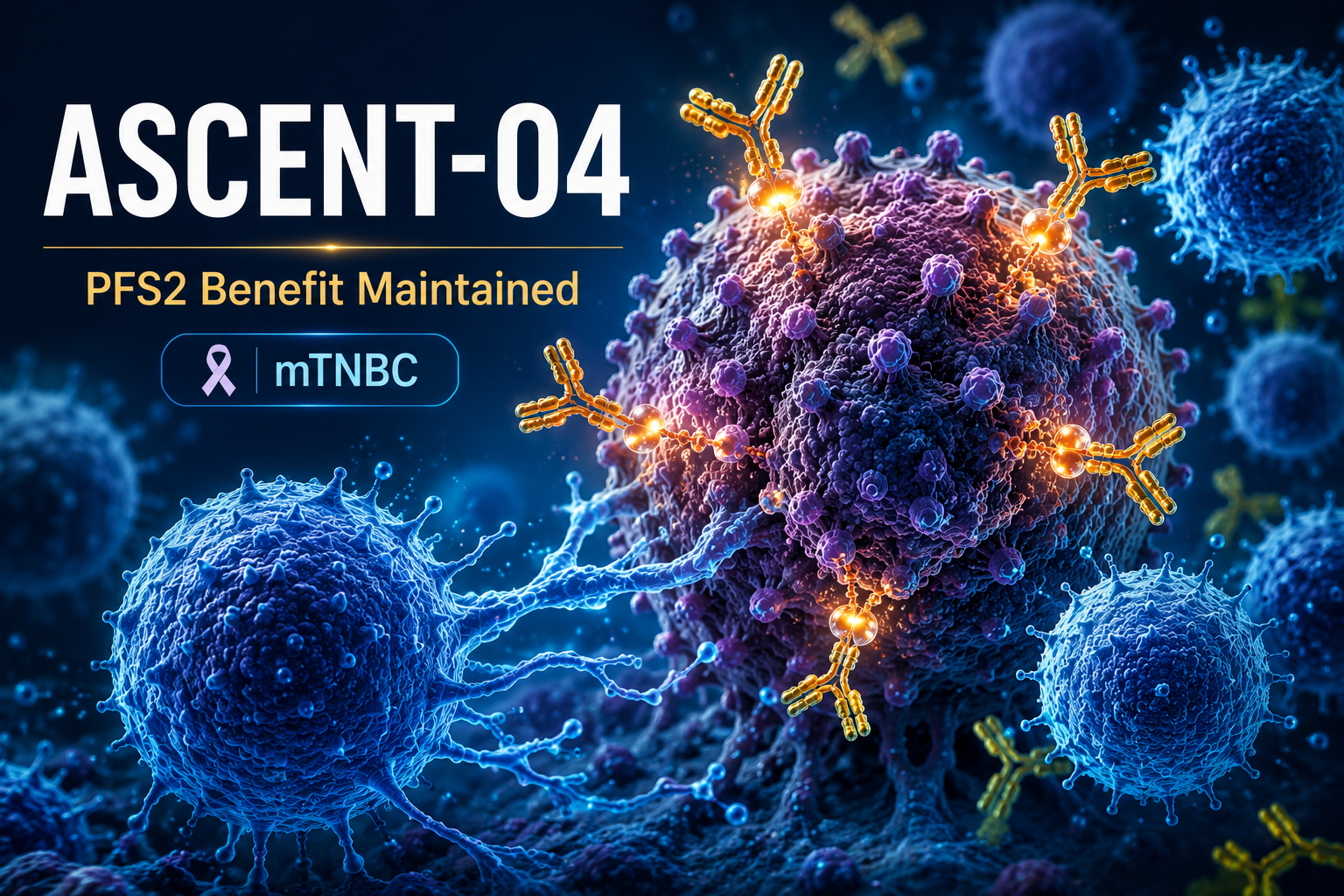
The phase III ASCENT-04 trial continues to demonstrate promising outcomes for the combination of sacituzumab govitecan and pembrolizumab in previously untreated PD-L1-positive metastatic triple-negative breast cancer (mTNBC). Updated results presented at the 2026 ASCO Annual Meeting showed a statistically significant improvement in progression-free survival 2 (PFS2) compared with pembrolizumab plus chemotherapy, despite substantial crossover to sacituzumab govitecan in the control arm. These findings reinforce the potential of this antibody-drug conjugate and immune checkpoint inhibitor combination as a new first-line treatment standard for patients with PD-L1-positive mTNBC.
Clinical Takeaway
The combination of sacituzumab govitecan plus pembrolizumab demonstrated a statistically significant improvement in PFS2 compared with pembrolizumab plus chemotherapy in previously untreated patients with PD-L1-positive mTNBC. Because PFS2 measures the time to progression following subsequent therapy or death, it provides important insight into the durability of treatment benefit beyond initial disease progression and is increasingly recognized as a surrogate for long-term clinical outcomes.
Drug Profile & Mechanism
- Sacituzumab govitecan (Trodelvy®): Anti-Trop-2 antibody-drug conjugate that delivers SN-38, the active metabolite of irinotecan, directly to tumor cells expressing Trop-2
- Pembrolizumab (Keytruda®): Anti-PD-1 monoclonal antibody that blocks the PD-1/PD-L1 pathway to enhance T-cell-mediated antitumor immunity
- Rationale for combination: Potential synergy between targeted cytotoxic delivery and immune checkpoint inhibition, potentially enhancing antitumor activity in PD-L1-positive TNBC
Target Population
- Previously untreated patients with metastatic TNBC or locally advanced unresectable TNBC
- PD-L1-positive tumors (Combined Positive Score ≥10 using 22C3 assay)
- Patients eligible for first-line systemic therapy
- Adequate performance status and organ function
Study Design
- Study type: Randomized, open-label, phase III trial
- Treatment arms:
- Experimental arm: Sacituzumab govitecan plus pembrolizumab (n=221)
- Control arm: Pembrolizumab plus chemotherapy (n=222)
- Crossover permitted: Patients in the control arm could receive sacituzumab govitecan as second-line therapy after disease progression
- Enrollment: 443 patients from 26 countries with previously untreated PD-L1-positive metastatic TNBC (mTNBC)
- Primary endpoint: Progression-free survival (PFS)
- Key secondary endpoints: Overall survival (OS), overall response rate (ORR), duration of response, PFS2, safety
Efficacy Outcomes
- PFS2 improvement: PFS2 was significantly improved with sacituzumab govitecan plus pembrolizumab, with the median PFS2 not reached, compared with 21.0 months in the pembrolizumab plus chemotherapy arm.
- Clinical significance: The improvement in PFS2 suggests that the benefit of first-line sacituzumab govitecan plus pembrolizumab extends beyond initial disease progression and persists through subsequent lines of therapy.
- Biomarker correlation: Benefit was observed in patients with PD-L1-positive tumors, supporting biomarker-driven treatment selection in first-line mTNBC.
- Time to first subsequent therapy: Median time to first subsequent treatment was 17.3 months with sacituzumab govitecan plus pembrolizumab versus 9.8 months with pembrolizumab plus chemotherapy.
- PFS2 rates: PFS2 rates favored sacituzumab govitecan plus pembrolizumab at 1 year (80.0% vs 75.7%), 18 months (71.9% vs 53.0%), and 2 years (63.7% vs 45.6%).
- Benefit despite crossover: Among patients receiving subsequent therapy in the chemotherapy arm, 81% received sacituzumab govitecan as second-line treatment, yet the PFS2 benefit remained in favor of upfront sacituzumab govitecan plus pembrolizumab.
Safety Profile
No new safety findings were highlighted in this updated analysis. The safety profile of sacituzumab govitecan plus pembrolizumab remained consistent with the established safety profiles of the individual agents.
Key Clinical Implications
✔ Improved PFS2 supports durable clinical benefit beyond initial disease progression in patients with PD-L1-positive mTNBC
✔ Combination approach may optimize outcomes by leveraging both targeted cytotoxicity and immune activation
✔ PD-L1 testing remains critical for patient selection and treatment planning in first-line metastatic TNBC
✔ Results further support sacituzumab govitecan plus pembrolizumab as a potential first-line standard of care for PD-L1-positive mTNBC
Bottom Line
Updated ASCENT-04 results demonstrate that sacituzumab govitecan plus pembrolizumab significantly improves PFS2 compared with pembrolizumab plus chemotherapy in previously untreated patients with PD-L1-positive mTNBC. Notably, this benefit was maintained despite substantial crossover to sacituzumab govitecan in the control arm, supporting the use of the combination in the first-line setting and strengthening its potential role as a new standard of care for this biomarker-defined population.
Sources:
- American Society of Clinical Oncology. Sacituzumab govitecan with pembrolizumab extends progression-free survival 2 for some people with metastatic triple-negative breast cancer. Published June 2, 2026. Accessed June 11, 2026. https://www.asco.org/about-asco/press-center/sacituzumab-govitecan-pembrolizumab-extends-PFS2-metastatic-triple-negative