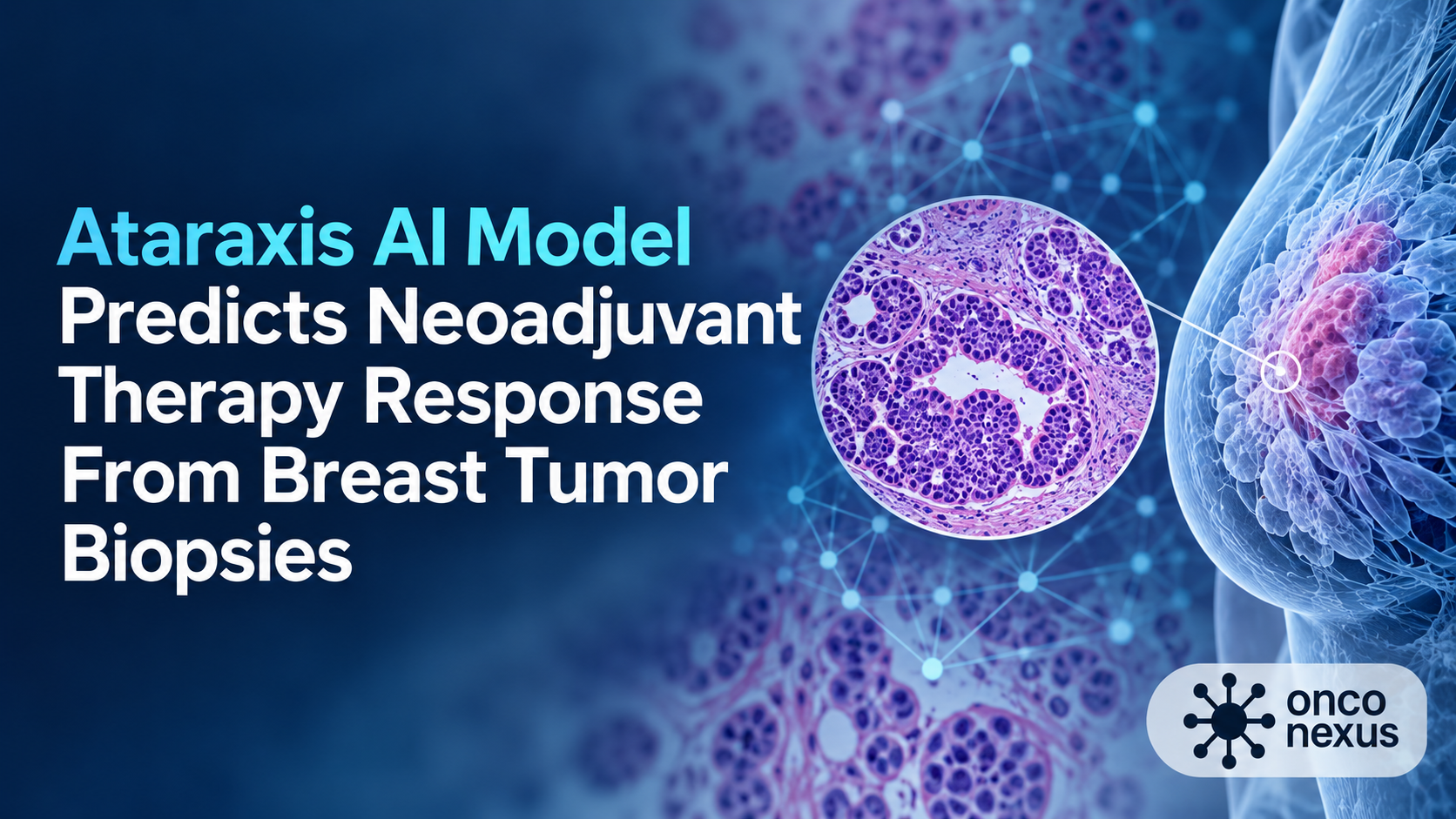
Ataraxis AI has published details of a two-stage artificial intelligence framework designed to predict pathological complete response (pCR) to neoadjuvant therapy in breast cancer patients using routine pre-treatment biopsy slides. The system, described in a technical report from the company, pairs two AI models (MORPHEUS, which estimates gene expression from histology images, and NEO, which translates that virtual molecular portrait into a pCR probability) to address the well-documented data scarcity that has limited prior deep-learning approaches in this setting.
NEO was reported to demonstrate “excellent discriminative performance” for neoadjuvant therapy response across 1,412 patients drawn from geographically and molecularly diverse real-world cohorts, and was additionally evaluated in two clinical trials. Specific numerical performance metrics, such as AUC values or sensitivity and specificity figures, were not disclosed in the published abstract and summary.
Key finding
The NEO model demonstrated what Ataraxis characterized as excellent discriminative performance for predicting pathological complete response to neoadjuvant therapy across 1,412 real-world breast cancer patients, though quantitative performance metrics were not reported in the publicly available summary.
Study Design
| Model | MORPHEUS (gene expression estimation) and NEO (pCR prediction), developed and reported by Ataraxis AI |
|---|---|
| Population | NEO trained on 1,080 patients across five cohorts; evaluated in 1,412 patients across geographically and molecularly diverse real-world cohorts; overall dataset assembled from 2,492 patients across 14 cohorts in seven countries |
| Input | Digitized H&E-stained core needle biopsy slides taken at diagnosis, combined with routine clinical variables |
| Primary endpoint | Prediction of pathological complete response (pCR) — defined as no invasive cancer remaining in the breast or lymph nodes at surgery — prior to initiation of neoadjuvant therapy |
The development approach was designed around a fundamental data-scarcity problem: patients are eligible for model training only if they received neoadjuvant therapy, had a digitized pre-treatment biopsy slide, and had their surgical response recorded. Ataraxis reports that fewer than 10% of its broader early breast cancer dataset of tens of thousands of patients met all three criteria. To overcome the limited pCR label volume, MORPHEUS was first trained on paired H&E slides and measured gene expression data from 8,742 patients across 32 cancer types in The Cancer Genome Atlas, generating virtual gene expression estimates for 14,773 genes per patient as a richer training signal. NEO was then trained to map those virtual molecular portraits to pCR outcomes, rather than learning the relationship between tissue morphology and response from scratch.
Results and Safety
Ataraxis reports that NEO achieved excellent discriminative performance in the 1,412-patient real-world validation cohort. The model was additionally evaluated in two clinical trials, where the company states predictions may help inform specific treatment decisions, though details of those trials and the nature of the decisions assessed were not specified in the available summary. Quantitative outputs, including AUC, sensitivity, specificity, or comparison to existing clinical predictors, were not disclosed.
The company also reports that NEO predictions were stable regardless of biopsy site and the amount of tissue sampled, a finding described as a deliberate stress-test of the model against conditions it is likely to encounter in clinical practice. Separately, analysis of MORPHEUS identified which molecular signals the model detects in pathology images, with those findings described as verified by expert pathologists. No safety or adverse event data were applicable to this AI model evaluation.
Clinical Context
Neoadjuvant therapy is increasingly standard of care for breast cancer, with pCR serving as both a surgical and prognostic milestone. Ataraxis notes that approximately two in three patients do not achieve pCR, and that reliable pre-treatment response prediction could support individualized decisions around treatment intensity, potentially identifying likely responders as candidates for de-escalation and flagging high-risk patients for escalation strategies. The company points out that no existing predictor of neoadjuvant therapy response has achieved FDA approval or a recommendation in clinical guidelines, underscoring an unmet need the NEO model is intended to address.
Whether NEO will be submitted for regulatory review, integrated into prospective clinical trials as a decision-support tool, or validated in head-to-head comparisons with established molecular assays has not been announced. The current publication represents a technical and analytical description of the model; independent peer-reviewed validation and prospective clinical evidence would be prerequisites before any routine clinical adoption.
Sources
- Ataraxis AI. “Biologically-informed AI predicts treatment response from tumor biopsies.” Technical report / model description. Date not specified. View source.
AI disclosure: This article was prepared with assistance from generative AI using the source material cited above. It was reviewed and edited by Hailey Pash, MSN, APN, before publication.