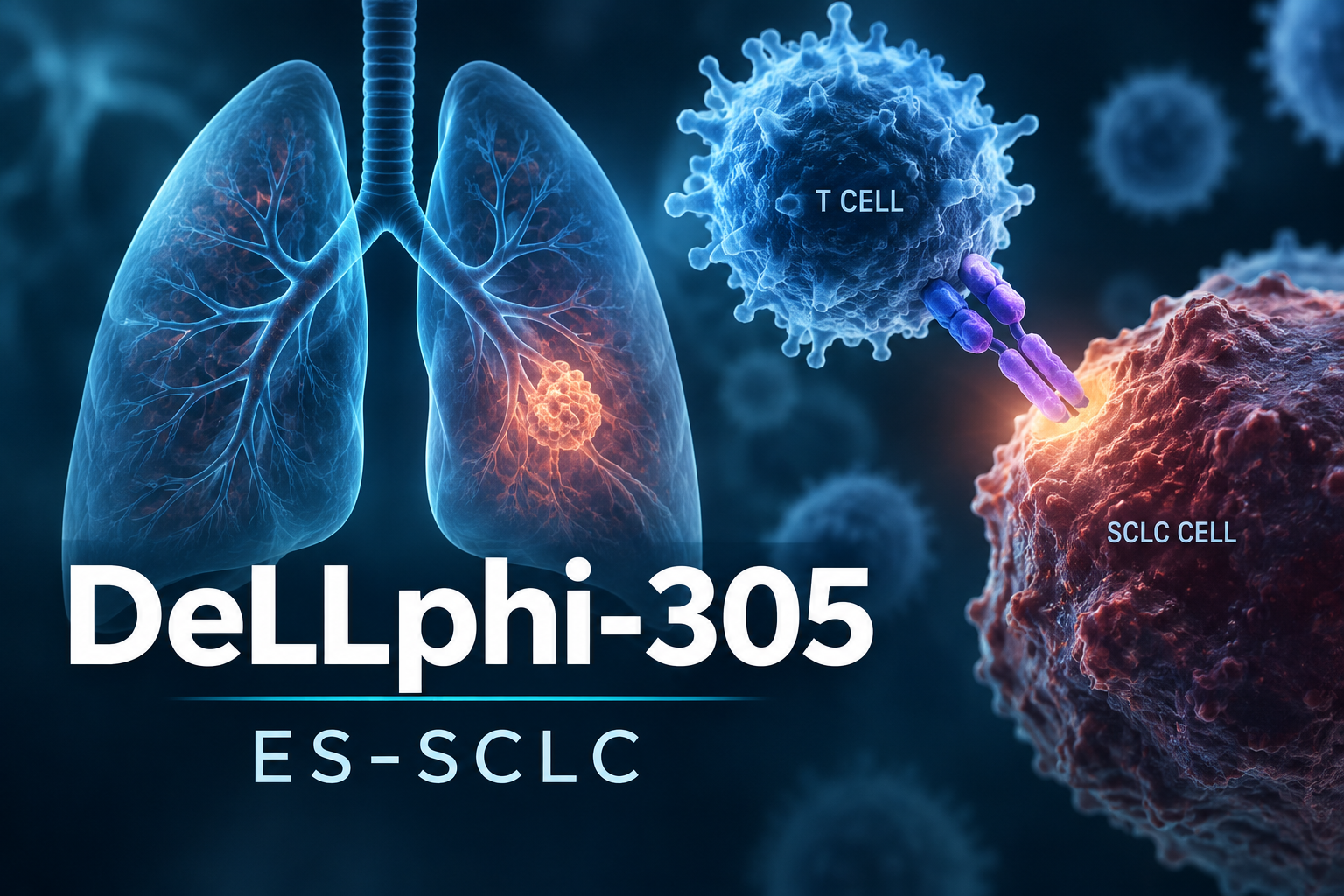
Results from the phase 3 DeLLphi-305 trial demonstrate that tarlatamab-dlle (IMDELLTRA®) in combination with durvalumab (Imfinzi®) delivers a statistically significant and clinically meaningful overall survival (OS) benefit compared to durvalumab alone as first-line maintenance therapy in patients with extensive-stage small cell lung cancer (ES-SCLC). These results mark the first phase 3 demonstration of an OS benefit with a Bispecific T-cell Engager (BiTE®) therapy in the first-line maintenance setting for ES-SCLC, representing a potential paradigm shift in how this aggressive malignancy is managed earlier in the treatment journey.
Clinical Takeaway
✔ Tarlatamab plus durvalumab significantly improved OS, PFS, and ORR versus durvalumab alone as first-line maintenance therapy in ES-SCLC, meeting the primary OS endpoint and secondary PFS and ORR endpoints at a pre-specified interim analysis.
✔ This is the first BiTE therapy to demonstrate an OS benefit in the first-line maintenance setting for ES-SCLC, representing an important milestone in a disease where median survival from first-line maintenance is approximately one year.
✔ The safety profile was consistent with known profiles of the individual agents, with no new or unexpected safety signals identified.
Drug Profile & Mechanism
- Drug: Tarlatamab-dlle (IMDELLTRA®), developed by Amgen
- Class: First-in-class Bispecific T-cell Engager (BiTE®) immunotherapy
- Mechanism: Engineered to simultaneously bind DLL3 on tumor cells and CD3 on T cells, forming a cytolytic synapse that activates T cells to kill DLL3-expressing SCLC cells
- Target rationale: DLL3 is expressed on the surface of SCLC cells in approximately 85–96% of patients with SCLC, with minimal expression on healthy cells, making it an attractive therapeutic target
- Combination partner: Durvalumab (Imfinzi®), an anti-PD-L1 checkpoint inhibitor
- Current U.S. approval: IMDELLTRA is indicated for adult patients with ES-SCLC with disease progression on or after platinum-based chemotherapy
Target Population & Disease Context
- Disease: Extensive-stage small cell lung cancer (ES-SCLC), one of the most aggressive malignancies, accounting for approximately 13–15% of the more than 2.6 million lung cancer cases diagnosed worldwide each year
- Unmet need: Despite available therapies, median survival from the start of first-line maintenance is approximately one year, and only ~40% of patients ever reach second-line therapy
- Key barrier: Many patients with ES-SCLC relapse rapidly on current therapy and do not access subsequent lines of treatment, underscoring the critical importance of advancing outcomes in the first-line setting
- Study population: Patients with ES-SCLC whose disease had not progressed following induction treatment with durvalumab, platinum-based chemotherapy, and etoposide; included patients with both treated and untreated asymptomatic brain metastases at baseline
Study Design
- Trial name: DeLLphi-305
- Phase: Global Phase 3, randomized, open-label
- Sponsor: Amgen, with partial funding and durvalumab provided by AstraZeneca
- Enrollment: 563 patients who had completed induction treatment with durvalumab, platinum-based chemotherapy, and etoposide without disease progression
- Randomization: 1:1 to tarlatamab + durvalumab versus durvalumab alone
- Treatment duration: Until disease progression or unacceptable toxicity
- DeLLphi-305 monitoring protocol:
- Patients monitored in a healthcare setting for 1 to 2 hours following IMDELLTRA infusion on Cycle 1 Day 1 and Cycle 1 Day 8
- In certain regions including Europe: 6 to 8 hours of monitoring required
- Brain metastases: Trial included patients with both treated and untreated asymptomatic brain metastases at baseline
- Analysis timing: Pre-specified interim analysis
Endpoints
- Primary endpoint: Overall survival (OS)
- Secondary endpoints:
- Progression-free survival (PFS)
- Objective response rate (ORR)
Efficacy Outcomes
- Overall survival (primary endpoint): Tarlatamab plus durvalumab demonstrated a statistically significant and clinically meaningful improvement in OS versus durvalumab alone at a pre-specified interim analysis, making this the first Phase 3 BiTE therapy trial to achieve an OS benefit in the first-line maintenance setting for ES-SCLC
- Progression-free survival (secondary endpoint): A statistically significant and clinically meaningful improvement in PFS was demonstrated for the tarlatamab combination arm
- Objective response rate (secondary endpoint): A statistically significant and clinically meaningful improvement in ORR was observed in patients treated with tarlatamab plus durvalumab
- The primary OS endpoint and secondary PFS and ORR endpoints were met at the interim analysis
- Detailed quantitative data will be presented at an upcoming international medical congress and submitted to regulatory authorities
Safety
The overall safety profile of tarlatamab in combination with durvalumab in DeLLphi-305 was consistent with the known safety profiles of the individual agents. No new or unexpected safety signals were identified. Detailed safety results from DeLLphi-305 have not yet been reported.
Tarlatamab carries a Boxed Warning for cytokine release syndrome (CRS) and neurologic toxicity, including immune effector cell-associated neurotoxicity syndrome (ICANS), which can be life-threatening or fatal. Other established safety considerations include cytopenias, infections, hepatotoxicity, and hypersensitivity. Step-up dosing and appropriate monitoring are required under the current U.S. prescribing information.
Broader Tarlatamab Clinical Program
DeLLphi-305 is part of a broader clinical development program evaluating tarlatamab across multiple stages and lines of SCLC treatment. The trial builds on DeLLphi-303, which evaluated tarlatamab in combination with standard-of-care therapies in first-line ES-SCLC. Additional phase 3 studies are evaluating tarlatamab in second-line SCLC, limited-stage SCLC, and first-line ES-SCLC induction and maintenance strategies.
Key Clinical Implications
✔ DeLLphi-305 establishes tarlatamab as a meaningful advance in the first-line maintenance setting for ES-SCLC, a space where improving OS has historically been extremely difficult to achieve.
✔ Clinicians treating patients who have not progressed after first-line durvalumab-based chemoimmunotherapy should be aware of this emerging regimen as a potential new standard, pending regulatory review and full data disclosure.
✔ The inclusion of patients with treated and untreated asymptomatic brain metastases in DeLLphi-305 provides important evidence in a clinically relevant ES-SCLC population.
✔ Given the aggressive natural history of ES-SCLC and the high proportion of patients who never reach second-line therapy, moving an effective agent like tarlatamab earlier in the treatment course represents a critical strategic advantage.
✔ CRS and neurologic toxicity management remain essential with tarlatamab; oncology teams should ensure appropriate infrastructure and patient education are in place.
✔ Full quantitative efficacy data are anticipated at an upcoming international medical congress, which will be critical for informing treatment algorithms and regulatory submissions.
Bottom Line
The phase 3 DeLLphi-305 trial demonstrates that tarlatamab plus durvalumab significantly improves overall survival, progression-free survival, and objective response rate versus durvalumab alone in patients with ES-SCLC who had not progressed following first-line chemoimmunotherapy. This is the first phase 3 study including a BiTE therapy to demonstrate an OS benefit in first-line maintenance ES-SCLC. With detailed efficacy data still pending, the findings position tarlatamab plus durvalumab as a potential new first-line maintenance option, pending regulatory review.
Sources:
- Amgen. IMDELLTRA in combination with IMFINZI demonstrated landmark improvement in overall survival in first-line extensive stage small cell lung cancer. Published September 8, 2026. https://www.amgen.com/newsroom/press-releases/2026/09/imdelltra-in-combination-with-imfinzi-demonstrated-landmark-improvement-in-overall-survival-in-first-line-extensive-stage-small-cell-lung-cancer