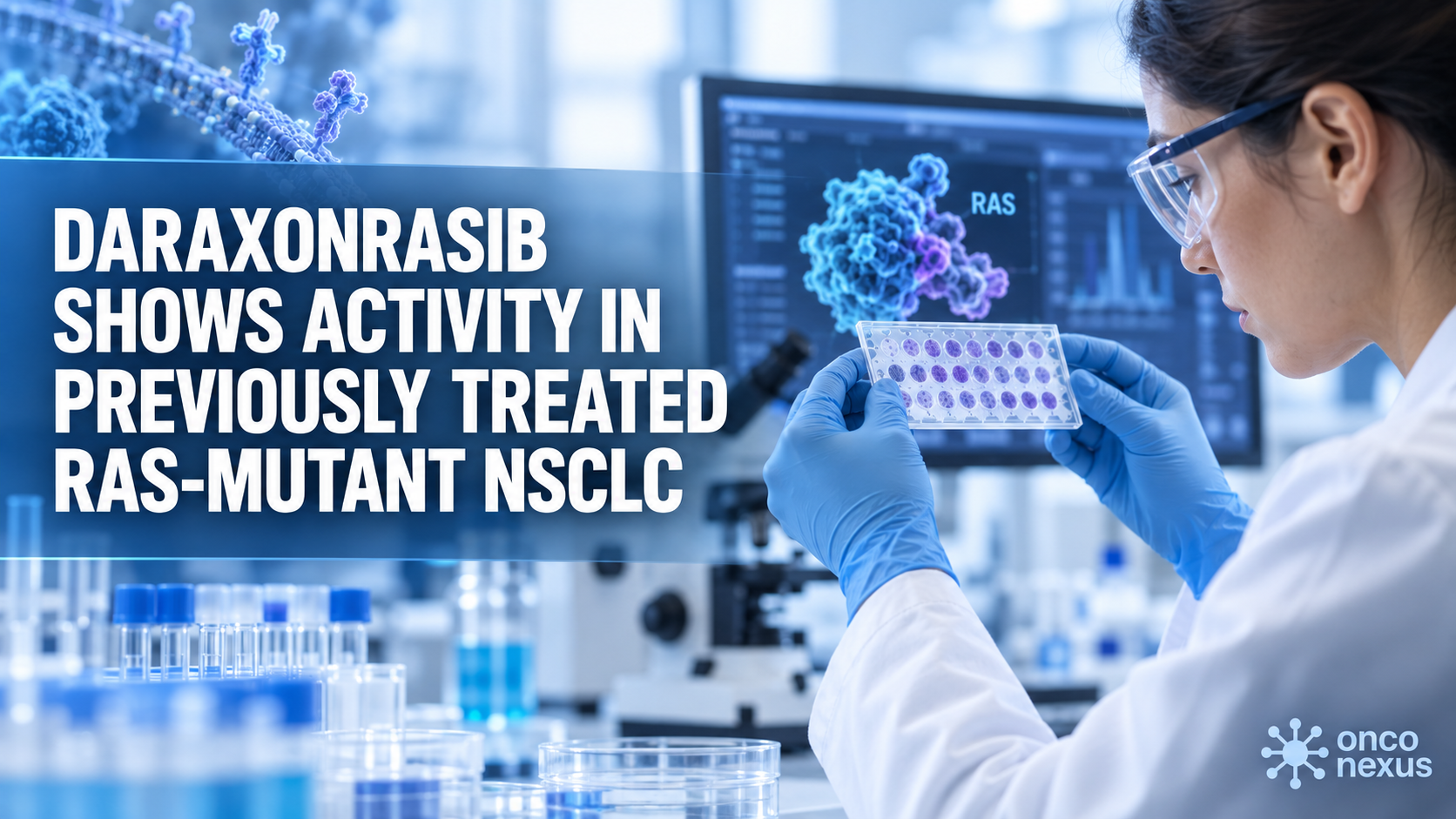
The New England Journal of Medicine recently published Phase 1/2 clinical data from the RMC-6236-001 trial evaluating daraxonrasib (RASONQUE), an oral RAS(ON) multi-selective inhibitor, in patients with previously treated advanced RAS-mutant non-small cell lung cancer (NSCLC) harboring mutations other than RAS G12C.
In a prespecified subgroup of 38 docetaxel-naïve patients treated at doses of 160 mg to 220 mg who had received prior platinum-based chemotherapy and anti-PD-(L)1 therapy, daraxonrasib produced a confirmed objective response rate of 42% and a disease control rate of 89%, with a median progression-free survival of 8.3 months and a median overall survival of 16.0 months. The data are from a Phase 1/2 dose-finding trial and have not yet been confirmed in a randomized controlled setting.
Key finding
In a subgroup of docetaxel-naïve patients with non-G12C RAS-mutant NSCLC treated with daraxonrasib at 160–220 mg, the confirmed objective response rate was 42% and median overall survival was 16.0 months. The results are from a single-arm Phase 1/2 trial and remain to be validated in the ongoing randomized Phase 3 RASolve 301 study.
Study Design
| Trial | RMC-6236-001 (NCT05379985), Phase 1/2; data cutoff July 21, 2025 |
|---|---|
| Population | 136 patients with second-line or later advanced NSCLC bearing RAS mutations other than G12C, whose disease had progressed on or who were intolerant to platinum-based chemotherapy and anti-PD-(L)1 therapy |
| Treatment | Daraxonrasib administered orally once daily at doses of 300 mg or less; key efficacy subgroup analyzed at 160–220 mg |
| Primary endpoint | Safety |
| Key secondary endpoints | Objective response rate, duration of response |
The trial enrolled patients across a range of non-G12C RAS mutation subtypes, reflecting the broader population for whom no approved targeted therapy currently exists. The efficacy analysis highlighted in the NEJM publication focused on a subgroup of 38 docetaxel-naïve patients within the 160–220 mg dose cohort who had received one or two prior lines of therapy including platinum-based chemotherapy and anti-PD-(L)1 treatment, aligning with the patient population being studied in the Phase 3 RASolve 301 trial.
Results and Safety
In the 38-patient docetaxel-naïve subgroup treated at 160–220 mg, the confirmed objective response rate was 42% (95% CI, 26%–59%) and the disease control rate was 89% (95% CI, 75%–97%). Median progression-free survival was 8.3 months (95% CI, 4.0–12.5 months) and median overall survival was 16.0 months (95% CI, 9.5 months–not estimable). Across the full 136-patient population, Revolution Medicines reported dose-dependent antitumor activity, though disaggregated efficacy data for the full cohort were not detailed in the company’s announcement.
At the 160–220 mg dose levels, Grade 3 treatment-related adverse events occurred in 25% of patients; the most common were rash (8%) and diarrhea (3%). No Grade 4 or Grade 5 treatment-related adverse events were reported within this dose range. The company characterized the overall safety profile as manageable, though longer-term safety data were not described in the source material.
Clinical Context
RAS mutations are among the most prevalent oncogenic drivers in NSCLC, occurring in approximately 30% of cases. Approved targeted options in this space are currently limited to RAS G12C inhibitors, leaving patients with other RAS mutations without a targeted therapy option after progression on standard chemoimmunotherapy. The daraxonrasib data, if confirmed in a randomized setting, could represent a meaningful expansion of targeted treatment in this underserved group.
Revolution Medicines has initiated RASolve 301 (NCT06881784), a global, randomized, open-label Phase 3 trial comparing daraxonrasib with docetaxel in patients with previously treated locally advanced or metastatic RAS-mutant NSCLC. Daraxonrasib remains investigational for this indication; the drug received FDA approval for metastatic pancreatic cancer, which the company cited as additional validation of its RAS(ON) inhibitor platform. Whether the response rates and survival outcomes observed in the Phase 1/2 subgroup will be replicated in the larger, controlled Phase 3 trial remains to be seen.
Sources
- Arbour KC et al. Daraxonrasib for Previously Treated RAS-Mutant Non–Small-Cell Lung Cancer. N Engl J Med 2026 (395);882-93. doi:10.1056/NEJMoa25040
- Revolution Medicines, Inc. “New England Journal of Medicine Publishes Phase 1/2 Clinical Data on Revolution Medicines’ RASONQUE™ (daraxonrasib) in Metastatic Non-Small Cell Lung Cancer.” Press release. September 2, 2026. View source.
AI disclosure: This article was prepared with assistance from generative AI using the source material cited above. It was reviewed and edited by Brandon Twyford before publication.