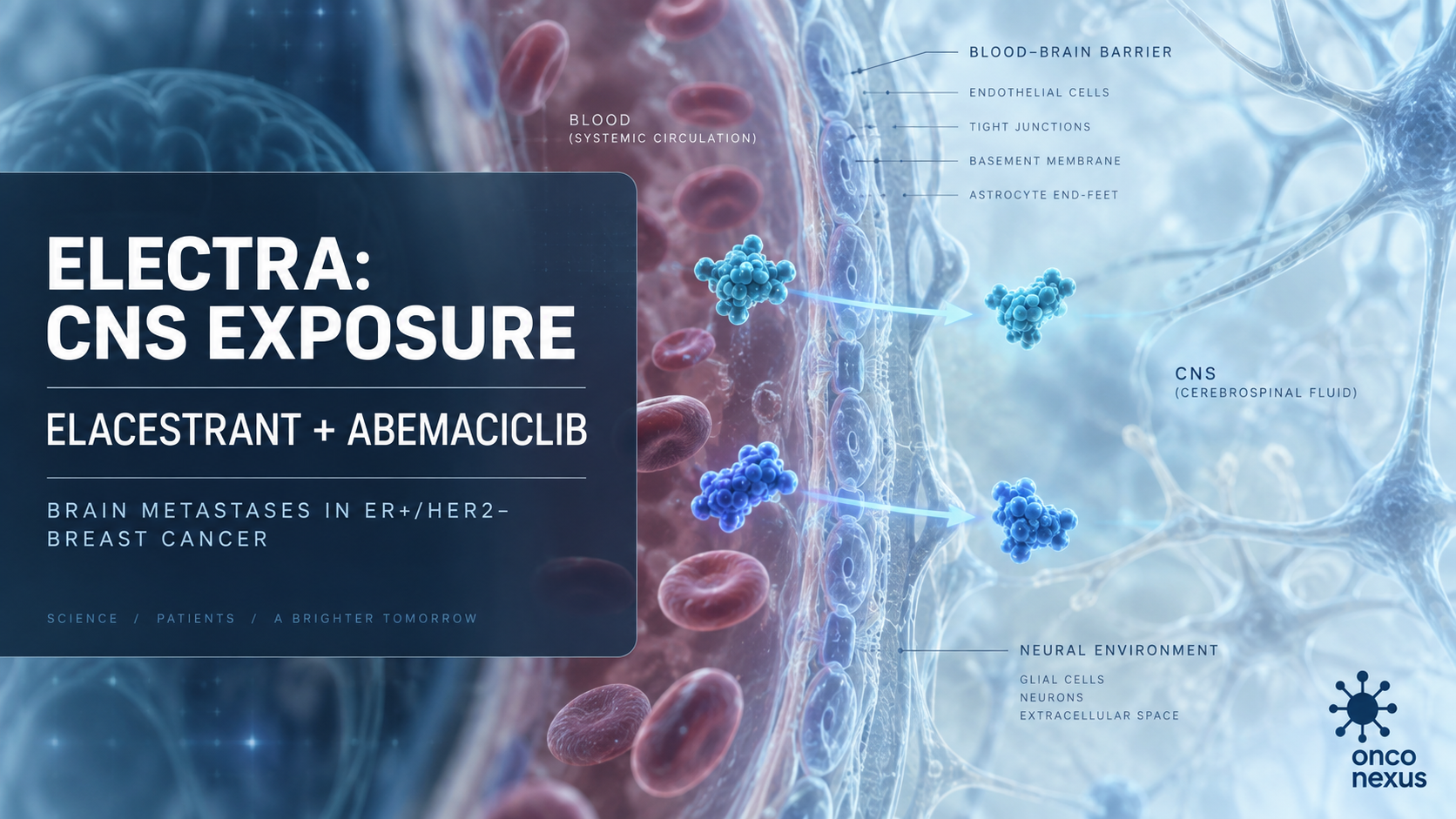
Researchers have reported preliminary findings from a prospective observational study evaluating the cerebrospinal fluid (CSF) penetration of elacestrant combined with abemaciclib in patients with hormone receptor-positive (HR+), HER2-negative breast cancer and active brain metastases. Published in Neuro-Oncology Advances, the data offer early pharmacokinetic evidence that both agents can be detected in the CSF of patients with this difficult-to-treat disease subset.
Both elacestrant and abemaciclib were measurable in CSF samples obtained from enrolled patients, suggesting central nervous system (CNS) penetration of the combination regimen. The authors cautioned that the study enrolled a small number of patients and that the clinical significance of the observed CSF drug levels remains to be established in larger, prospective trials.
Key finding
In a small prospective observational study, both elacestrant and abemaciclib were detectable in the CSF of patients with HR+/HER2-negative breast cancer and active brain metastases, providing early pharmacokinetic evidence of CNS penetration, though the study had a limited sample size, and the authors cautioned against drawing definitive conclusions about clinical efficacy.
Study Design
| Trial | ELECTRA: Prospective observational study |
|---|---|
| Population | Patients with HR+/HER2-negative breast cancer and active brain metastases |
| Treatment | Elacestrant plus abemaciclib |
| Primary endpoint | CSF pharmacokinetics (detection and quantification of drug concentrations in CSF) |
The study was designed to characterize the CNS pharmacokinetics of the elacestrant-plus-abemaciclib combination, an area of clinical importance given that patients with HR+/HER2-negative metastatic breast cancer increasingly develop brain metastases and represent a population with limited systemic treatment options known to penetrate the CNS effectively.
Results and Safety
CSF samples collected from patients on the combination regimen confirmed detectable concentrations of both elacestrant and abemaciclib, indicating that neither agent is entirely excluded by the blood-brain barrier in this patient population. The reported findings focus primarily on pharmacokinetic data; quantitative CSF drug concentration values and their relationship to plasma levels were described in the publication, though a detailed numerical breakdown of CSF-to-plasma ratios was not prominently foregrounded.
Clinical response data, including intracranial objective response rates and progression-free survival outcomes, were not the primary focus of this pharmacokinetic report.
Clinical Context
Brain metastases in HR+/HER2-negative breast cancer represent a growing clinical challenge, as this subtype was historically considered less prone to CNS involvement than HER2-positive or triple-negative disease. However, with improvements in systemic disease control and longer patient survival, the incidence of CNS metastases in this population has risen. Demonstrating that orally administered endocrine-based therapies such as elacestrant, a selective estrogen receptor degrader, and abemaciclib, a CDK4/6 inhibitor, can penetrate the CSF is a necessary, if preliminary, step toward establishing their potential utility in managing CNS disease.
Whether measurable CSF drug concentrations translate into meaningful intracranial antitumor activity remains an open question. Larger, randomized studies with prospectively defined CNS endpoints will be required to determine whether this combination offers durable clinical benefit for patients with active breast cancer brain metastases. The current findings nonetheless provide a pharmacological rationale for continued investigation of this regimen in the CNS setting.
Sources
- Lin NU, et al. ELECTRA: AN OPEN-LABEL, MULTICENTER, PHASE 1B/2 STUDY OF ELACESTRANT IN COMBINATION WITH ABEMACICLIB IN PATIENTS WITH BRAIN METASTASES FROM ER+/HER2– BREAST CANCER. Neurooncol Adv. 2026 Aug 7;8(Suppl 6):vdag161.016. doi: 10.1093/noajnl/vdag161.016.
AI disclosure: This article was prepared with assistance from generative AI using the source material cited above. It was reviewed and edited by Brandon Twyford before publication.