ZUSDURI (intravesical mitomycin gel) is an outpatient chemoblative therapy evaluated in the Phase 3 ENVISION trial for recurrent low-grade intermediate-risk non–muscle invasive bladder cancer (LG-IR-NMIBC). The study demonstrated a high 3-month complete response rate (~79.6%) and sustained durability among responders, with an estimated 64.5% remaining event-free at 36 months and median duration of response not yet reached. These findings support a potential shift toward non-surgical tumor control with reduced reliance on repeat transurethral resection of bladder tumor (TURBT) procedures.
ZUSDURI
Therapeutic Goal = Non-surgical tumor ablation and reduction of repeat TURBT procedures
- Indication: Recurrent low-grade intermediate-risk non-muscle invasive bladder cancer (LG-IR-NMIBC)
- Target Population: Adults with recurrent LG-IR-NMIBC after prior bladder surgery/transurethral resection of bladder tumor (TURBT) failure or recurrence
- Manufacturer: UroGen Pharma
- Drug Class/Type: Intravesical chemoblative therapy
- Active Agent: Mitomycin
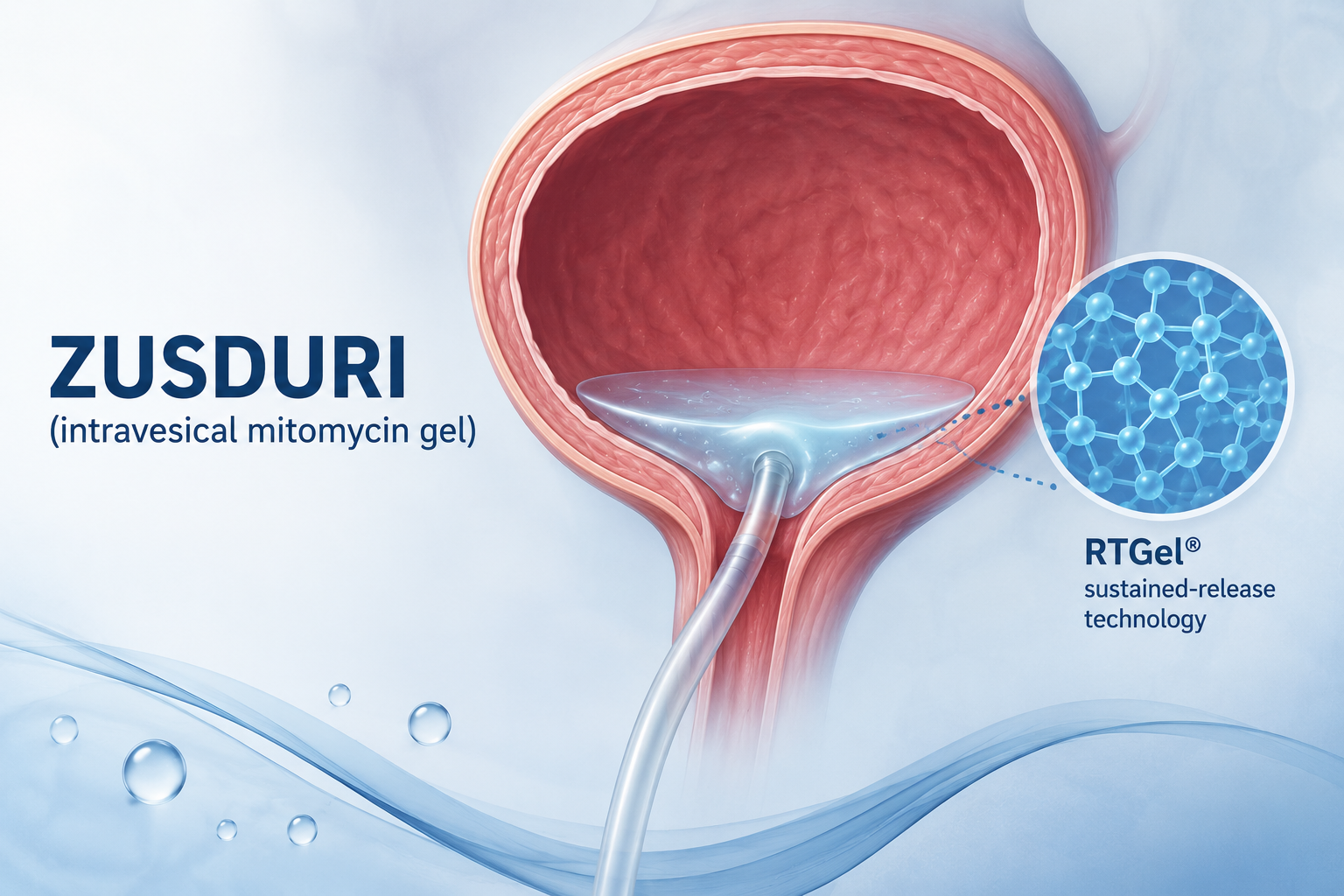
- Formulation Technology: Proprietary RTGel reverse thermal hydrogel sustained-release platform
- Administration Route: Intravesical instillation into the bladder via urinary catheter
- Setting of Administration: Outpatient/in-office procedure
- Dosing Schedule: Once weekly for 6 weeks
ENVISION Study Design (NCT05243550)
- Method: Phase 3, Multicenter, multinational, single-arm study
- Study Objective: Determine whether a non-surgical, chemoblative intravesical therapy can achieve durable eradication in recurrent LG-IR-NMIBC, potentially reducing reliance on TURBT
- Primary Objective: Evaluate complete response (CR) rate at 3 months after treatment with intravesical ZUSDURI
- Key Secondary Objective: Assess durability of response (DOR) over time among patients achieving CR at 3 months
- Participants: ~240 patients from 56 clinical sites
- Key baseline context:
- High recurrence disease phenotype (often requires repeated TURBT)
- Older population with comorbidities typical of NMIBC epidemiology
- Key baseline context:
Primary Outcomes
- Primary Outcome: 3-month CR rate
- 79.6% of treated patients achieved a complete response at 3 months after initiation of therapy
- Key Secondary Outcomes: DOR among 3-month CR responders
- Median DOR:
- Not reached at a median follow-up of ~35.5 months
- Kaplan–Meier estimated event-free (durability) rates among responders:
- 24 months: 72.2%
- 36 months: 64.5%
- Median DOR:
Safety
- Overall tolerability:
- ZUSDURI was generally well tolerated in the study population
- Most adverse events were mild to moderate in severity
- Safety profile was consistent with a local intravesical chemotherapy exposure pattern, rather than systemic toxicity dominance
- Treatment-Emergent Adverse Events (TEAEs):
- Common adverse events:
- Dysuria
- Hematuria
- Urinary tract infection (UTI)
- Urinary frequency/irritative voiding symptoms
- These events are consistent with:
- Local urothelial irritation
- Post-instillation inflammatory response
- Instrumentation-related effects (catheterization + intravesical exposure)
- These events are consistent with:
- Common adverse events:
- Serious Adverse Events (SAEs):
- Approximately ~12% of patients experienced serious adverse events
- Reported SAEs were generally urologic in nature, including:
- Urinary retention (0.8%)
- Urethral stenosis (0.4%)
- No dominant signal of unexpected systemic toxicity was reported
Safety profile aligns with a locally active bladder-directed therapy, not systemic cytotoxic chemotherapy exposure.
Clinical Implications
- ✔ Sustained non-surgical disease control is biologically plausible: A 64.5% 3-year event-free rate among complete responders suggests that durable bladder tumor eradication can be achieved without immediate or repeated TURBT in a substantial subset of patients with recurrent LG-IR-NMIBC.
- ✔ Reduced Invasive Procedures: High NPV allows many patients to defer cystoscopy without compromising safety
- ✔ Depth of initial response is clinically meaningful: The high 3-month CR rate (~79.6%) functions as a strong early predictor of long-term benefit – Clinically, this reinforces the idea that early cystoscopic response stratification is a decision point for surveillance intensity and retreatment planning
- ✔ Durability supports a “watchful surveillance after response” model: With median duration of response not reached at ~36 months follow-up, responders may 1) Avoid frequent early re-intervention and 2) Transition into structured cystoscopic monitoring rather than preemptive TURBT cycles
- ✔ Reinforces the “field effect” management concept in NMIBC: Sustained responses suggest broader urothelial field treatment rather than focal resection-only control.
Limitations
- Single-arm durability context
- Lack of randomized comparator means:
- Durability cannot be directly benchmarked against TURBT or intravesical chemotherapy arms in a controlled fashion
- Lack of randomized comparator means:
- Clinical adoption will rely on:
- Cross-trial historical comparisons
- Real-world recurrence rates in similar risk populations
Sources:
- UroGen Pharma Ltd. ZUSDURI median duration of response still not reached with 64.5% 36-month duration of response in the pivotal ENVISION trial. UroGen Pharma Investor Relations. Published May 13, 2026. Accessed May 14, 2026. https://investors.urogen.com/news-releases/news-release-details/zusduri-median-duration-response-still-not-reached-645-36-month
- Prasad SM, Shishkov D, Mihaylov NV, et al. Primary Chemoablation of Recurrent Low-Grade Intermediate-Risk Nonmuscle-Invasive Bladder Cancer With UGN-102: A Single-Arm, Open-Label, Phase 3 Trial (ENVISIPrasad SM, Shishkov D, Mihaylov NV, et al. Primary Chemoablation of Recurrent Low-Grade Intermediate-Risk Nonmuscle-Invasive Bladder Cancer With UGN-102: A Single-Arm, Open-Label, Phase 3 Trial (ENVISION). J Urol. 2025;213(2):205-216. doi:10.1097/JU.0000000000004296ON). J Urol. 2025;213(2):205-216. doi:10.1097/JU.0000000000004296
- Prasad SM, Shishkov D, Mihaylov NV, et al. UGN-102 for Recurrent Low-Grade Intermediate-Risk Non-Muscle-Invasive Bladder Cancer: A 24-Month Duration of Response Results From the Phase 3 ENVISION Trial. J Urol. Published online March 25, 2026. doi:10.1097/JU.0000000000005041