The U.S. Food and Drug Administration (FDA) has accepted for review a New Drug Application (NDA) for daraxonrasib, an investigational oral RAS(ON) multi-selective inhibitor developed by Revolution Medicines, for the treatment of patients with previously treated metastatic pancreatic ductal adenocarcinoma (PDAC). The acceptance marks a significant regulatory milestone for what would be the first agent in this mechanistic class to reach approval, supported by Phase 3 data demonstrating unprecedented improvements in survival outcomes.
Clinical Takeaway1
The FDA’s acceptance of the daraxonrasib NDA positions this first-in-class oral RAS(ON) multi-selective inhibitor as a potential new standard of care for patients with previously treated metastatic PDAC. The application is backed by the Phase 3 RASolute 302 trial, which met all primary and key secondary endpoints—including statistically significant and clinically meaningful improvements in overall survival (OS) and progression-free survival (PFS)—versus standard-of-care cytotoxic chemotherapy. Daraxonrasib has also received Breakthrough Therapy Designation, Orphan Drug Designation, and selection for the FDA Commissioner’s National Priority Voucher pilot program, reflecting the urgent unmet need in this patient population.
Drug Profile & Mechanism1
- Drug name: Daraxonrasib
- Developer: Revolution Medicines, Inc. (Nasdaq: RVMD)
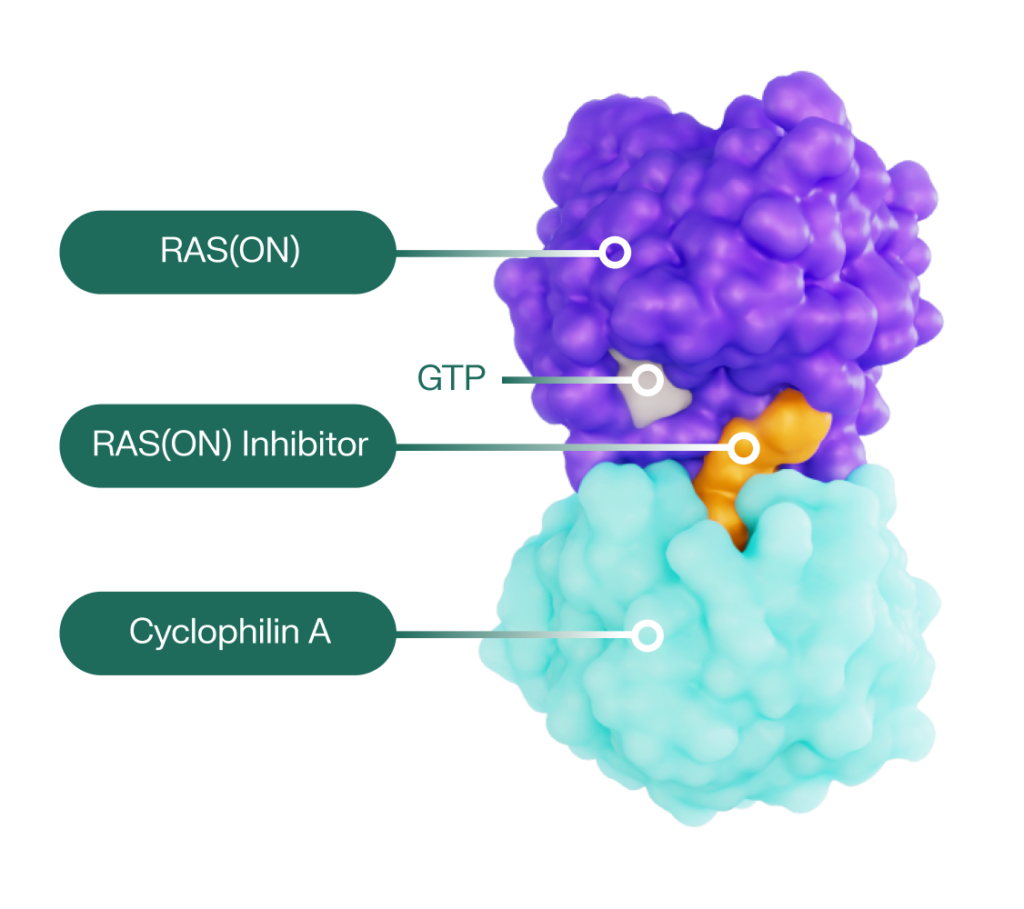
- Class: Oral, investigational RAS(ON) multi-selective, noncovalent tri-complex inhibitor
- Mechanism: Suppresses RAS signaling by inhibiting the interaction between both wild-type and mutant RAS(ON) proteins and their downstream effectors, targeting the active (ON) state of RAS
- RAS genotypes targeted: Broad coverage including RAS G12 mutations (G12D, G12V, G12R) and RAS wild-type tumors
- Intended tumor types: PDAC, non-small cell lung cancer (NSCLC), and colorectal cancer
- Route of administration: Oral, 300 mg once daily
Disease Background & Unmet Need2-4
PDAC represents one of oncology’s most formidable challenges. Key epidemiological and clinical facts underscore the severity of the unmet need:
- Approximately 60,000 new diagnoses of pancreatic cancer are made annually in the U.S., with approximately 50,000 deaths per year.2
- The majority of patients are diagnosed at an advanced or metastatic stage due to the absence of early symptoms and reliable detection methods.2
- Metastatic PDAC carries a five-year survival rate of approximately 3%, among the lowest of any solid tumor.3,4
- RAS mutations—present in the vast majority of PDAC tumors—represent the central oncogenic driver of this disease, yet have historically been considered undruggable.3
- Standard second-line options remain limited to cytotoxic chemotherapy regimens with modest efficacy and significant toxicity burden.3
Target Population
- Patients with previously treated metastatic PDAC
- Eligible regardless of tumor RAS mutation status: includes patients with RAS G12 mutations (G12D, G12V, G12R) as well as those with RAS wild-type (no identified tumor RAS mutation) tumors
- Enrolled patients had received at least one prior line of therapy
Study Design: RASolute 3025
- Trial identifier: NCT06625320
- Design: Global, randomized, Phase 3 registrational clinical trial
- Comparator: Investigator’s choice of four cytotoxic chemotherapy regimens representing standard of care globally
- Experimental arm: Oral daraxonrasib 300 mg once daily
- Population: Patients with previously treated metastatic PDAC, inclusive of RAS G12 mutant and RAS wild-type tumors
- Data presentation: Results were presented at the 2026 American Society of Clinical Oncology (ASCO) Annual Meeting (LBA5) with simultaneous publication in The New England Journal of Medicine
Endpoints6,7
- Co-primary endpoints:
- Progression-free survival (PFS) as assessed by Blinded Independent Central Review (BICR) per RECIST 1.1 in patients with RAS G12 mutant tumors
- Overall survival (OS) in patients with RAS G12 mutant tumors.
- Key secondary endpoints:
- PFS and OS in the intent-to-treat (ITT) population (all enrolled patients, including RAS wild-type).
- Objective response rate (ORR)
- Duration of response (DoR)
- Patient-reported outcomes (PROs) including cancer-related pain, overall global health status, and quality of life
Efficacy Outcomes1,6,7
The RASolute 302 trial met all primary and key secondary endpoints, with Revolution Medicines characterizing the survival improvements as unprecedented in this patient population:
- Overall survival: Statistically significant and clinically meaningful improvement over standard-of-care chemotherapy in the RAS G12 mutant population
- Progression-free survival: Statistically significant improvement over chemotherapy per BICR/RECIST 1.1 in the RAS G12 mutant population
- ITT population: Both PFS and OS benefits were also observed across all enrolled patients, including those without an identified tumor RAS mutation
- Patient-reported outcomes: Patients treated with daraxonrasib reported significantly delayed deterioration in cancer-related pain, overall global health status, and quality of life compared to those receiving chemotherapy
Safety
Daraxonrasib demonstrated a manageable safety profile in the RASolute 302 trial. Detailed adverse event data will be available in the full publication in The New England Journal of Medicine. The overall tolerability profile, combined with the oral once-daily dosing schedule and patient-reported quality-of-life benefits, contrasts favorably with the toxicity burden typically associated with cytotoxic chemotherapy regimens used in this setting.
Regulatory & Development Context
- FDA designations:
- Breakthrough Therapy Designation for previously treated metastatic PDAC
- Orphan Drug Designation for previously treated metastatic PDAC
- Selected for the FDA Commissioner’s National Priority Voucher pilot program, designed to accelerate review of medicines addressing key national health priorities
- European regulatory activity:
- The European Medicines Agency (EMA) Committee for Medicinal Products for Human Use (CHMP) has initiated a phased (rolling) review of daraxonrasib, enabling evaluation of data as they become available prior to submission of a full Marketing Authorization Application (MAA)
- Received Orphan Medicine Designation in Europe for pancreatic cancer
- Granted high-priority status under the EMA Cancer Medicines Pathfinder project based on its potential to address a significant unmet medical need
- Broader development program: Daraxonrasib is being evaluated across a global Phase 3 program comprising four registrational trials, including three additional trials in patients with PDAC and metastatic RAS-mutant NSCLC
Key Clinical Implications
✔ Daraxonrasib represents the first RAS(ON) multi-selective inhibitor to reach NDA review, potentially inaugurating an entirely new class of RAS-targeted therapies for PDAC.
✔ The broad eligibility criteria—encompassing both RAS G12 mutant and RAS wild-type patients—suggest a wide applicable patient population if approved, without requiring restriction to a specific RAS genotype.
✔ Survival improvements described as “unprecedented” in Phase 3 PDAC trials, combined with a manageable safety profile and oral once-daily dosing, could meaningfully shift second-line treatment paradigms for metastatic PDAC.
✔ Patient-reported quality-of-life benefits—including delayed deterioration in cancer-related pain and global health status—are clinically meaningful in a disease where symptom burden is high, and treatment options are poorly tolerated.
✔ Multiple accelerated regulatory designations (Breakthrough Therapy, National Priority Voucher, EMA rolling review) signal expedited pathways that may bring this agent to patients sooner than a conventional review timeline.
✔ Oncologists should anticipate updated guidelines and potential label language as the FDA review progresses; molecular profiling of PDAC tumors for RAS mutation status remains relevant for stratification and trial enrollment in the interim.
Bottom Line
The FDA’s acceptance of the daraxonrasib NDA for previously treated metastatic PDAC marks a pivotal moment in the treatment of one of oncology’s most lethal diseases. Supported by Phase 3 data from the RASolute 302 trial—demonstrating unprecedented OS and PFS improvements over standard chemotherapy, along with meaningful patient-reported quality-of-life benefits—daraxonrasib has the potential to establish a new standard of care and define a novel therapeutic class for RAS-driven malignancies. With accelerated regulatory designations in both the U.S. and Europe, the oncology community should prepare for the possible near-term availability of the first approved RAS(ON) multi-selective inhibitor.
Sources:
- Revolution Medicines, Inc. Revolution Medicines’ new drug application for daraxonrasib accepted for review by U.S. FDA for previously treated metastatic pancreatic cancer. News release. Published July 22, 2026. https://ir.revmed.com/news-releases/news-release-details/revolution-medicines-new-drug-application-daraxonrasib-accepted
- Siegel RL, Giaquinto AN, Jemal A. Cancer statistics, 2024. CA Cancer J Clin. 2024;74(1):12-49. doi:10.3322/caac.21820
- Halbrook CJ, Lyssiotis CA, Pasca di Magliano M, Maitra A. Pancreatic cancer: Advances and challenges. Cell. 2023;186(8):1729-1754. doi:10.1016/j.cell.2023.02.014
- American Cancer Society. Survival Rates for Pancreatic Cancer. Available at: https://www.cancer.org/cancer/types/pancreatic-cancer/detection-diagnosis-staging/survival-rates.html
- RASolute 302 trial registration: ClinicalTrials.gov Identifier NCT06625320. https://clinicaltrials.gov/study/NCT06625320
- Wolpin BM, Wainberg ZA, Hendifar AE, et al. Daraxonrasib, a RAS(ON) multi-selective inhibitor vs chemotherapy in previously treated metastatic pancreatic adenocarcinoma (mPDAC): primary and final analysis from the phase 3 RASolute 302 study. J Clin Oncol. 2026;44(17_suppl):LBA5. doi:10.1200/JCO.2026.44.17_suppl.LBA5
- O’Reilly EM, Wainberg ZA, Hendifar AE, et al; RASolute 302 Trial Investigators. Daraxonrasib or chemotherapy in previously treated metastatic pancreatic cancer. N Engl J Med. 2026;395(4):325-337. doi:10.1056/NEJMoa2605555