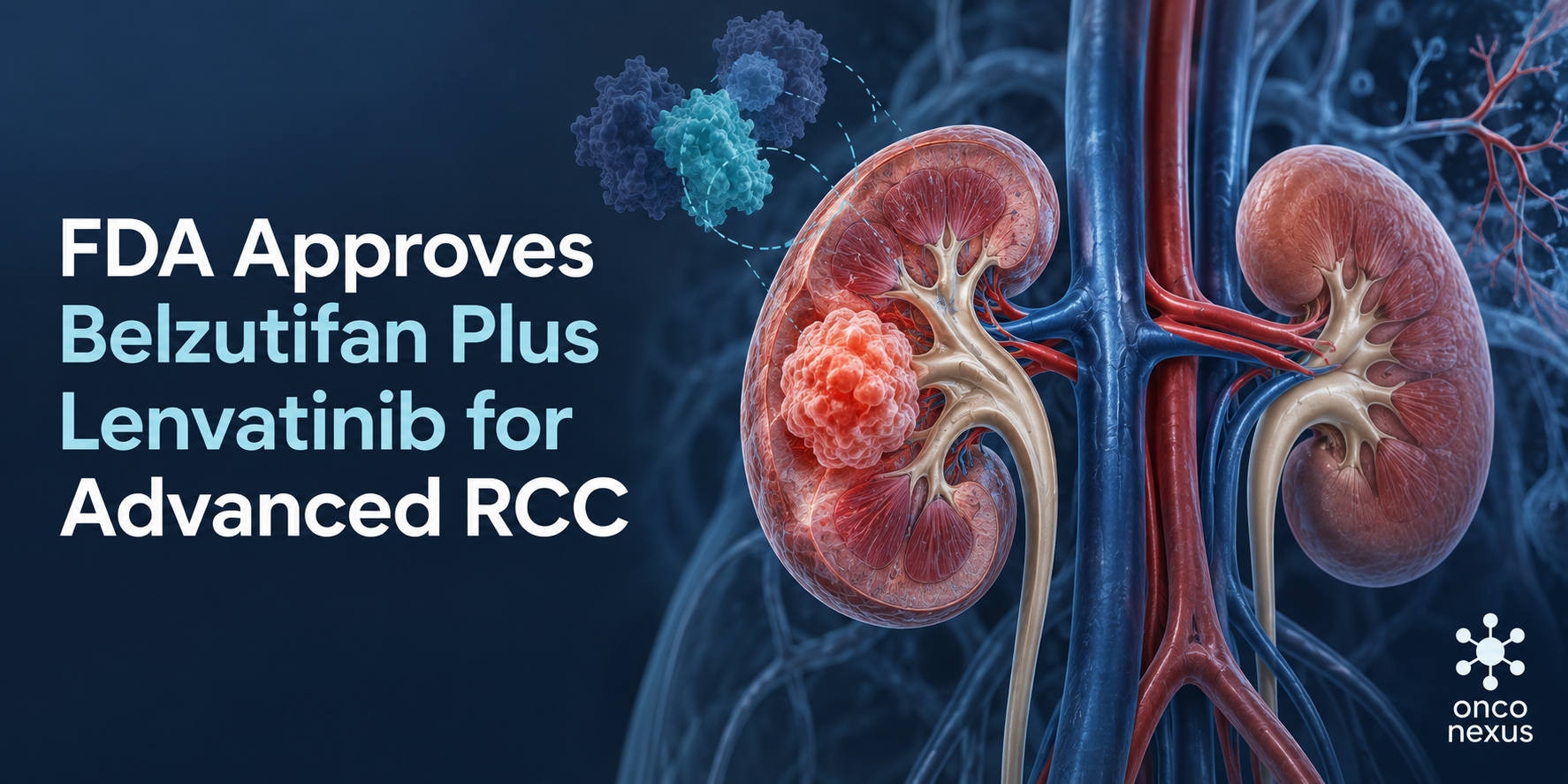
The U.S. Food and Drug Administration approved belzutifan (Welireg, Merck & Co., Inc.) in combination with lenvatinib (Lenvima, Eisai Inc.) on September 24, 2026, for adults with advanced renal cell carcinoma with a clear cell component (ccRCC) whose disease has progressed following treatment with a PD-1 or PD-L1 inhibitor.
The approval was supported by data from the LITESPARK-011 trial. In the LITESPARK-011 trial, the combination demonstrated a statistically significant improvement in progression-free survival over cabozantinib. Overall survival results, however, did not reach statistical significance at the final analysis.
Key finding
In LITESPARK-011, belzutifan plus lenvatinib reduced the risk of progression or death by 26% versus cabozantinib (HR 0.74; median PFS 14.6 vs. 10.6 months), though the combination did not achieve a statistically significant overall survival benefit at the final analysis.
Study Design
| Trial | LITESPARK-011 (NCT04586231); open-label, randomized, active-controlled |
|---|---|
| Population | 747 adults with locally advanced or metastatic ccRCC that progressed on or after a PD-1 or PD-L1 inhibitor, or within six months of completing adjuvant PD-1 inhibitor therapy |
| Treatment | Belzutifan 120 mg plus lenvatinib 20 mg once daily vs. cabozantinib (1:1 randomization) |
| Primary endpoints | Progression-free survival (PFS) by blinded independent central review per RECIST v1.1; overall survival (OS) |
| Key secondary endpoints | Objective response rate (ORR) |
LITESPARK-011 enrolled patients across both arms in a 1:1 ratio, with PFS and OS designated as the major efficacy outcome measures. ORR served as an additional efficacy endpoint. The FDA review used the Assessment Aid, a voluntary submission from the applicant intended to facilitate the agency’s evaluation.
Results and Safety
Belzutifan plus lenvatinib produced a statistically significant improvement in PFS compared with cabozantinib, with a median of 14.6 months (95% CI: 11.1, 16.6) versus 10.6 months (95% CI: 9.2, 11.1), yielding a hazard ratio of 0.74 (95% CI: 0.61, 0.89; one-sided p=0.00095). The ORR was 53% (95% CI: 47, 58) in the belzutifan-lenvatinib arm and 40% (95% CI: 35, 45) in the cabozantinib arm (one-sided p=0.0002). At the final OS analysis, the difference did not reach statistical significance: median OS was 33.7 months (95% CI: 29.0, 46.9) versus 28.6 months (95% CI: 24.1, 31.4), with a hazard ratio of 0.85 (95% CI: 0.70, 1.03).
The prescribing information includes a boxed warning for embryo-fetal toxicity and warnings for anemia, hypoxia, and cardiac dysfunction. Lenvatinib also carries warnings for several other serious adverse events. The FDA announcement did not provide detailed trial-level adverse event frequencies.
Clinical Context
The approval establishes belzutifan plus lenvatinib as a new option in the post-immunotherapy setting for advanced ccRCC, a space where cabozantinib has been a standard second-line choice. Belzutifan is a hypoxia-inducible factor-2 alpha (HIF-2α) inhibitor, and its combination with the multi-kinase inhibitor lenvatinib represents a mechanistically distinct approach from existing VEGFR-targeted monotherapies in this line of therapy.
The lack of a statistically significant OS benefit leaves an open question regarding the combination’s long-term impact on survival, and longer follow-up or additional analyses may be needed to clarify that finding. The recommended dosage is belzutifan 120 mg plus lenvatinib 20 mg orally once daily, continued until disease progression or unacceptable toxicity.
Sources
- U.S. Food and Drug Administration. “FDA Approves Belzutifan in Combination with Lenvatinib for Advanced Renal Cell Carcinoma with Clear Cell Component.” Regulatory approval announcement. September 24, 2026. View source.
AI disclosure: This article was prepared with assistance from generative AI using the source material cited above. It was reviewed and edited by Brandon Twyford before publication.