Ivonescimab, the first PD-1/VEGF bispecific antibody, demonstrated improved overall survival outcomes in previously untreated squamous non-small cell lung cancer (NSCLC) patients, delivering what investigators are calling a landmark advancement for this challenging patient population at the ASCO 2026 Plenary Session.
Clinical Takeaway
The HARMONi-6 trial represents a pivotal moment in squamous NSCLC treatment, with ivonescimab plus chemotherapy showing superior efficacy compared to tislelizumab plus chemotherapy in the frontline setting. This dual-targeting approach addresses both immune evasion and angiogenesis simultaneously, potentially overcoming resistance mechanisms that limit current immunotherapy approaches.
Drug Profile & Mechanism
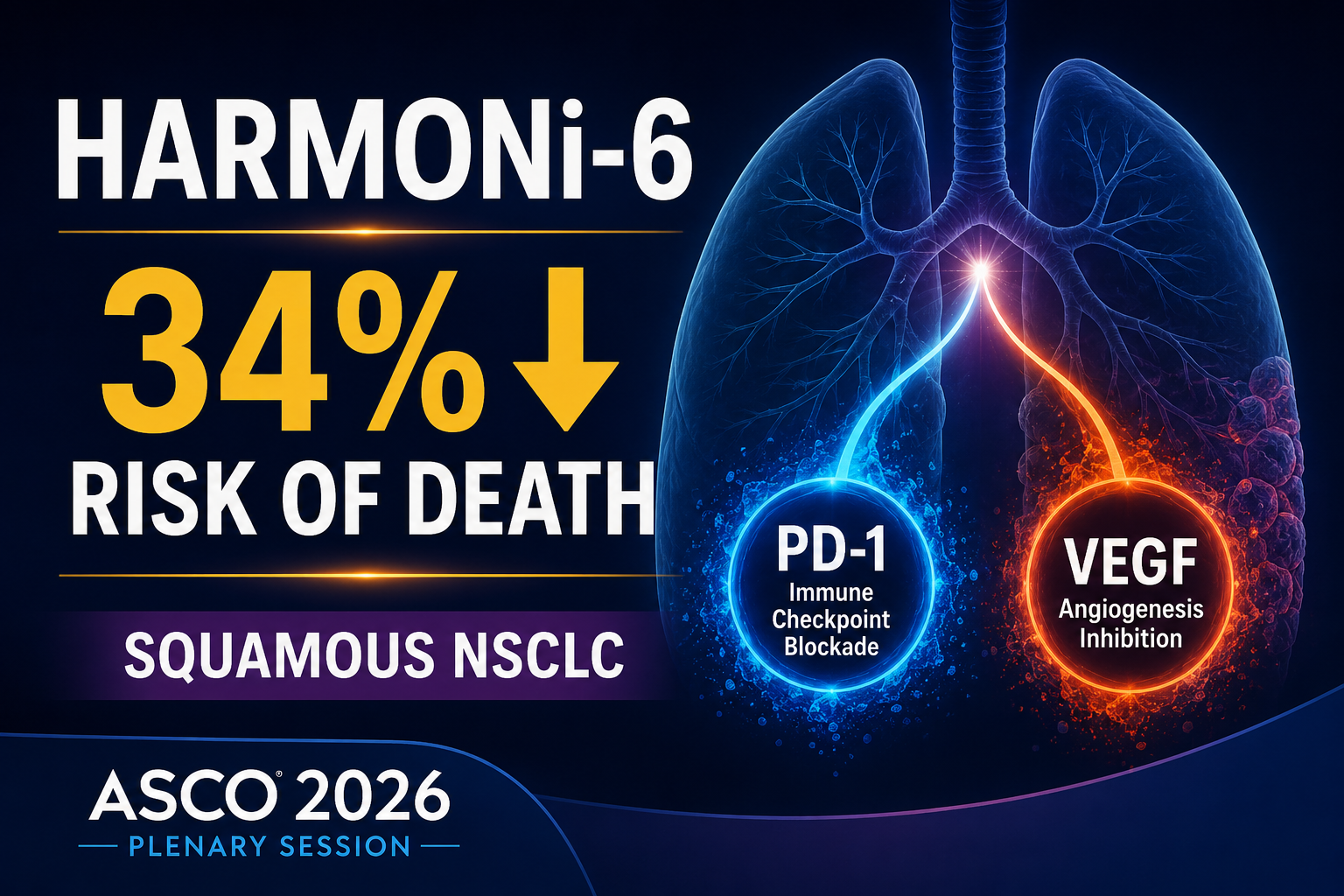
- Ivonescimab (AK112) is a novel bispecific antibody that simultaneously targets PD-1 and VEGF pathways
- Dual mechanism of action:
- Anti-PD-1 arm: Blocks immune checkpoint inhibition to restore T-cell activity
- Anti-VEGF arm: Inhibits angiogenesis and may normalize tumor vasculature to improve immune cell infiltration
- Developed by Akeso Pharmaceuticals as a PD-1/VEGF bispecific antibody
Target Population
- Treatment-naïve patients with advanced or metastatic squamous NSCLC
- ECOG performance status 0-1
- No requirement for specific PD-L1 expression levels (enrolled regardless of PD-L1 status)
- Patients suitable for platinum-based chemotherapy
Study Design
- Phase 3, randomized, double-blind, controlled trial
- Treatment arms:
- Experimental: Ivonescimab + carboplatin + paclitaxel
- Control: Tislelizumab + carboplatin + paclitaxel
- Randomization ratio: 1:1
- Enrollment: 532 patients enrolled in China
- Treatment schedule: 21-day cycles with standard dosing protocols
Primary & Secondary Endpoints
- Dual Primary Endpoints:
- Overall Survival (OS)
- Progression-Free Survival (PFS) by investigator assessment
- Key Secondary Endpoints:
- Objective Response Rate (ORR)
- Duration of Response (DoR)
- Safety and tolerability
- Quality of life measures
Efficacy Outcomes
The HARMONi-6 trial achieved both primary endpoints with statistically significant and clinically meaningful improvements favoring the ivonescimab combination:
- Overall Survival (OS): After a median follow-up of 21.4 months, median OS was approximately 28 months with ivonescimab plus chemotherapy versus 24 months with tislelizumab plus chemotherapy.
- Risk of Death: Ivonescimab treatment reduced the risk of death by 34% compared with tislelizumab plus chemotherapy.
- Progression-Free Survival (PFS): Earlier analyses demonstrated a median PFS of approximately 11 months with ivonescimab versus 9 months with tislelizumab.
- PD-L1 Subgroups: Ivonescimab demonstrated survival benefit regardless of PD-L1 expression level. Median OS was not reached in either the PD-L1 ≥1% or PD-L1 <1% subgroups, while outcomes with tislelizumab were less favorable in patients with PD-L1 <1%.
- Benefit Consistency: Clinical benefit was observed across key patient subgroups, including patients with low or absent PD-L1 expression.
Safety Profile
- Manageable safety profile consistent with known effects of individual pathway inhibition
- Expected toxicities: Combination of immune-related adverse events and anti-angiogenic effects
- No new safety signals identified beyond those anticipated for the dual mechanism
- Grade 3 or higher adverse events included neutropenia (32% vs 26%), leukopenia (11% vs 9%), and anemia (7% vs 5%) in the ivonescimab and tislelizumab arms, respectively.
- Bleeding events occurred in approximately 3% of patients receiving ivonescimab compared with 1% of patients receiving tislelizumab.
Key Clinical Implications
✔ First PD-1/VEGF bispecific to demonstrate overall survival superiority over tislelizumab plus chemotherapy in frontline squamous NSCLC
✔ Validates dual PD-1/VEGF targeting as a promising strategy to overcome immunotherapy resistance mechanisms
✔ Demonstrated survival benefit regardless of PD-L1 expression level, including patients with low or absent PD-L1 expression
✔ May address the unmet need for improved outcomes in squamous histology, which typically shows inferior responses to immunotherapy
✔ Sets precedent for bispecific approaches in lung cancer treatment paradigm
Bottom Line
The HARMONi-6 trial demonstrated improved overall survival (OS) and progression-free survival (PFS) with ivonescimab plus chemotherapy compared with tislelizumab plus chemotherapy in previously untreated advanced squamous NSCLC. The findings support dual PD-1/VEGF blockade as a promising therapeutic strategy and suggest that ivonescimab may emerge as an important future treatment option for patients regardless of PD-L1 expression status, pending additional global data and regulatory review.
Sources:
- American Society of Clinical Oncology. Ivonescimab may improve survival in squamous NSCLC. ASCO Press Center. Published May 31, 2026. Accessed June 10, 2026. https://www.asco.org/about-asco/press-center/ivonescimab-may-improve-survival-squamous-nsclc