
While overall colorectal cancer (CRC) incidence has declined in recent decades, early-onset colorectal cancer (EOCRC) — defined as CRC diagnosed before age 50 — continues to rise at an alarming rate. A new national inpatient analysis published by Hornstein and colleagues leveraged the National Inpatient Sample (NIS) to systematically characterize how symptom presentation differs between early-onset and late-onset disease, identifying constipation as a disproportionately strong clinical signal in younger patients, particularly women under 40.
Background & Clinical Context
According to SEER data (2002–2022), CRC incidence among adults under 50 has risen by 68%, while mortality in this age group has increased by 12%. By contrast, incidence among adults 65 and older fell by 48% over the same period. CRC is now the leading cause of cancer death in men under 50 and the second leading cause in women under 50. In response, the USPSTF and AGA lowered the recommended screening age from 50 to 45 in 2021. However, a substantial number of EOCRC cases still occur in patients under 45, highlighting the need for improved strategies to identify high-risk younger individuals — particularly those without established hereditary risk factors.
Nonspecific symptoms such as abdominal pain, bloating, and constipation are often attributed to benign gastrointestinal conditions in younger adults, contributing to diagnostic delays. Meanwhile, more traditionally recognized CRC warning signs — such as hematochezia, iron deficiency anemia, and bowel obstruction — frequently reflect more advanced disease at presentation.
Study Design
- Design: Retrospective case-control study using the Healthcare Cost and Utilization Project National Inpatient Sample (NIS), 2020–2022
- Database: The NIS is the largest publicly available all-payer inpatient database in the U.S., capturing over 6 million hospitalizations annually (20% stratified sample of U.S. hospital discharges)
- Matching: 1:1 age-matched controls drawn from a 1% random sample of all hospitalizations in the same period; a 10% random sample of LOCRC cases was used for computational feasibility
- Sample size: 18,017 EOCRC hospitalizations and 12,882 LOCRC hospitalizations analyzed
- Exposures: Gastrointestinal symptoms and paraneoplastic lab findings defined by ICD-10 codes (constipation, diarrhea, abdominal pain, nausea/vomiting, dyspepsia, hemorrhoids, melena/hematemesis, hematochezia, weight loss/anorexia, malaise/fatigue, iron deficiency anemia, thrombocytosis)
Key Findings: Symptom Associations
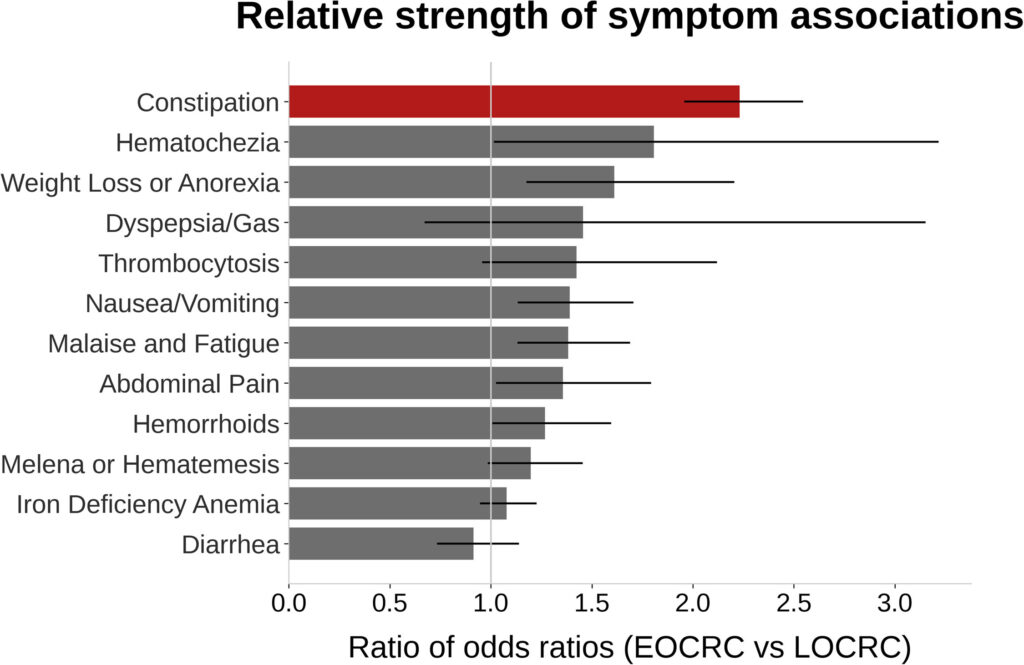
Compared with age-matched controls, several symptoms showed significantly higher adjusted odds ratios in EOCRC versus LOCRC, suggesting a distinct symptom profile in younger patients:
- Constipation: aOR 2.50 (95% CI: 2.29–2.73) in EOCRC vs. aOR 1.12 (95% CI: 1.02–1.24) in LOCRC — the most divergent symptom between age groups
- Hematochezia: aOR 14.8 in EOCRC vs. 8.19 in LOCRC (both p < 0.001)
- Thrombocytosis: aOR 5.74 in EOCRC vs. 4.03 in LOCRC (both p < 0.001)
- Hemorrhoids: aOR 4.07 in EOCRC vs. 3.21 in LOCRC (both p < 0.001)
- Weight loss or anorexia: aOR 4.06 in EOCRC vs. 2.52 in LOCRC (both p < 0.001)
- Iron deficiency anemia: aOR 3.63 in EOCRC vs. 3.37 in LOCRC (both p < 0.001)
- Melena or hematemesis: aOR 3.10 in EOCRC vs. 2.59 in LOCRC (both p < 0.001)
- Nausea/vomiting: aOR 2.46 in EOCRC vs. 1.77 in LOCRC (both p < 0.001)
- Abdominal pain: aOR 1.37 in EOCRC (p < 0.001) vs. 1.01 in LOCRC (p = 0.934 — not significant)
Constipation: Age- and Sex-Stratified Findings
Constipation demonstrated a graded inverse relationship with age in EOCRC, with the strongest association observed in the youngest patients:
- Under age 40 (combined): aOR 4.43 (95% CI: 3.66–5.37)
- Ages 40–44: aOR 2.10 (95% CI: 1.79–2.46)
- Ages 45–49: aOR 2.02 (95% CI: 1.77–2.30)
- Age 50+ (LOCRC): aOR 1.12 (95% CI: 1.02–1.24)
Sex-stratified analysis revealed a particularly pronounced signal in women under 40:
- Women under 40: aOR 5.72 (95% CI: 4.47–7.32, p < 0.001)
- Men under 40: aOR 2.79 (95% CI: 2.07–3.75, p < 0.001)
Overall, constipation was present in 10.2% of EOCRC hospitalizations vs. 4.8% of age-matched controls (p < 0.004). Across the full EOCRC cohort, constipation was more strongly associated in women (aOR 2.80) than men (aOR 2.12).
Colon Cancer Prevalence in Constipation-Related Hospitalizations
A key contextualizing finding concerned absolute cancer prevalence among constipation-related inpatient encounters compared to general hospitalizations:
- Among all hospitalizations for adults aged 45–49, colon cancer was present in 1.07% of admissions
- Among constipation-related hospitalizations, colon cancer prevalence was:
- Ages ≤34: 0.31% (RR 4.42; 95% CI: 3.69–5.30)
- Ages 35–39: 0.96% (RR 3.25; 95% CI: 2.77–3.80)
- Ages 40–44: 1.31% (RR 1.96; 95% CI: 1.72–2.20) — comparable to the 1.07% prevalence in all hospitalizations for adults 45–49
- Ages 45–49: 1.62% (RR 1.51; 95% CI: 1.38–1.62)
- Age ≥50: 1.19% (RR 1.09; 95% CI: 1.00–1.18)
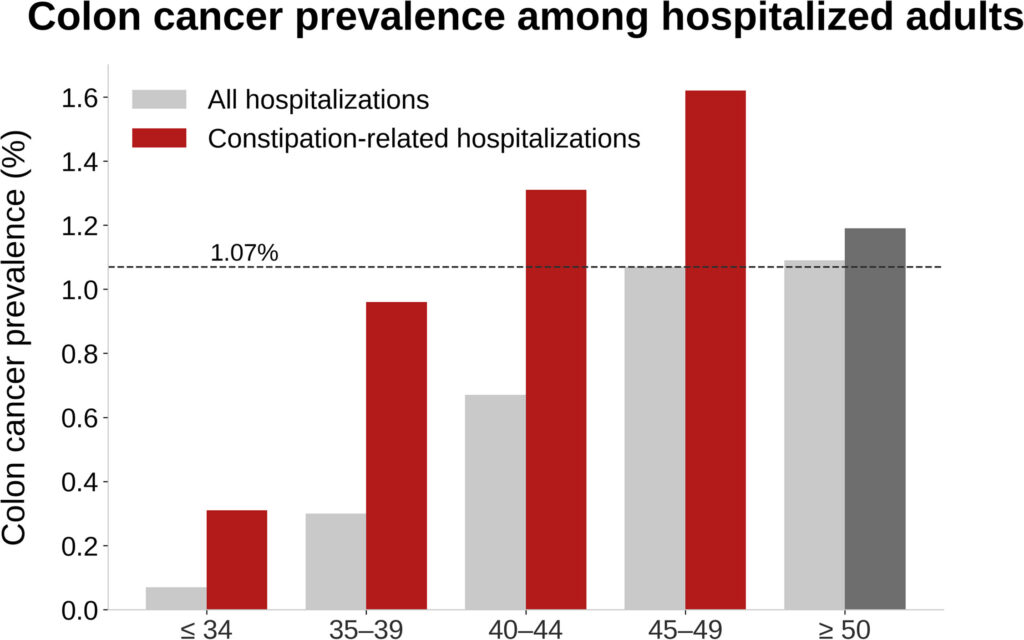
This finding suggests that hospitalized adults aged 40–44 presenting with constipation may carry a colon cancer risk profile comparable to that of the general inpatient population currently eligible for screening at age 45–49. However, the authors emphasize that absolute prevalence remained low across all groups, underscoring the need for cautious interpretation.
Additional Cohort Characteristics
- Tumor location: Left-sided or rectal tumors were significantly more common in EOCRC than LOCRC (76.9% vs. 61.6%, p < 0.0001), providing a potential anatomical explanation for the higher constipation signal in younger patients
- Metastatic disease at presentation: Higher in EOCRC than LOCRC (52.7% vs. 41.5%, p < 0.0001), consistent with later-stage diagnosis in younger adults
- Inpatient mortality: Paradoxically lower in EOCRC (3.0% vs. 4.7%, p < 0.0001), likely reflecting the younger baseline health status of this cohort despite higher metastatic burden
- Demographics: EOCRC patients were more likely to be male (53.6% vs. 43.1% in controls), privately insured (57.8% vs. 41.1%), and from higher-income ZIP codes
Limitations
- The NIS captures only inpatient encounters; findings may reflect more advanced or complicated disease and cannot be extrapolated to outpatient or early-stage presentations
- The cross-sectional design precludes causal inference; it is not possible to determine whether constipation preceded CRC diagnosis or arose in the context of disease progression or treatment
- Administrative ICD-10 coding is subject to documentation bias, coding variability, and misclassification; the NIS lacks outpatient data, staging information, and longitudinal follow-up
- Clinically relevant confounders such as opioid use, iron supplementation, and other medication-related causes of constipation are not reliably captured in the NIS
- The NIS records hospitalizations, not unique patients, potentially overrepresenting patients with repeated admissions (e.g., those with advanced disease)
- Despite significant relative associations, absolute colon cancer prevalence in constipation-related hospitalizations remained low, and these findings should not be used in isolation to guide screening decisions
Key Clinical Implications
✔ Constipation in younger adults — particularly women under 40 — should prompt heightened clinical vigilance for EOCRC, especially when persistent or worsening, even though absolute cancer risk remains low.
✔ The current clinical descriptor “change in bowel habits” may be insufficient; persistent constipation as a discrete symptom may warrant more specific attention in adults under 50 presenting to inpatient settings.
✔ Hospitalized adults aged 40–44 with constipation had a colon cancer prevalence (1.31%) comparable to the general inpatient population aged 45–49 (1.07%), suggesting this subgroup may represent a higher-risk presentation warranting further evaluation.
✔ Clinician-related delays and age bias in evaluating gastrointestinal symptoms in younger adults — particularly women — have been recognized as contributors to diagnostic delays in EOCRC and should be actively addressed.
✔ Prospective outpatient studies are needed to validate these inpatient-derived signals and to evaluate whether symptom-based risk stratification tools (potentially incorporating FIT testing and laboratory markers) could support earlier, individualized CRC screening in adults under 45.
Bottom Line
In this large national inpatient analysis, EOCRC demonstrated a distinct symptom profile compared with late-onset disease, with constipation emerging as the most divergent signal — carrying an aOR more than twice that seen in older patients and exceeding fourfold in adults under 40. The association was particularly pronounced in women under 40 (aOR 5.72). While absolute cancer prevalence in constipation-related hospitalizations remained low, this analysis provides hypothesis-generating evidence that data-driven symptom evaluation may help identify higher-risk clinical presentations in younger adults. These findings require prospective validation before they can inform changes to screening or diagnostic algorithms, but they underscore the importance of not dismissing atypical or persistent gastrointestinal complaints in younger patients — a group for whom CRC may not yet be top of mind.
Sources:
- Samaddar A, Basker S, Bawek S, et al. Characterizing symptom patterns in early-onset colorectal cancer: insights from a national inpatient analysis. Cancer Treat Res Commun. Published online June 13, 2026. doi:10.1016/j.ctarc.2026.101287
- Ashish Samaddar: Writing – review & editing, Writing – original draft, Validation, Software, Methodology, Formal analysis, Data curation, Conceptualization. Suriya Basker: Writing – review & editing. Sawyer Bawek: Writing – review & editing. Udhayvir Grewal: Writing – review & editing. Timothy J Brown: Writing – review & editing. Sepideh Gholami: Writing – review & editing. Lingzhi Liu: Writing – original draft, Writing – review & editing. Deepak Vadehra: Writing – review & editing. Nicholas Hornstein: Writing – review & editing, Supervision, Methodology, Investigation, Conceptualization.