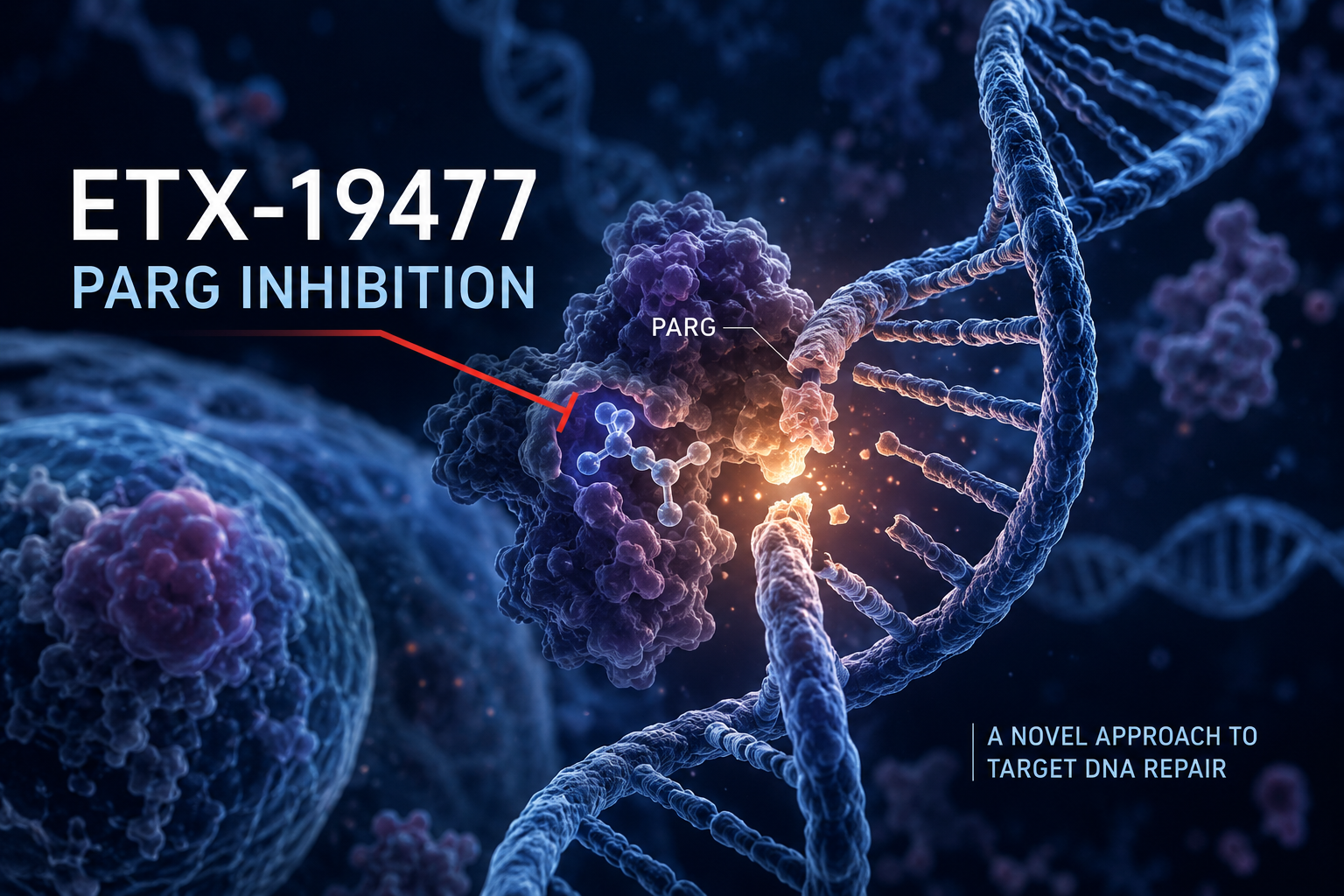
The U.S. Food and Drug Administration (FDA) has granted Fast Track designation to ETX-19477, an investigational poly(ADP-ribose) glycohydrolase (PARG) inhibitor developed by 858 Therapeutics, for the treatment of adult patients with BRCA-mutated, HR+/HER2− unresectable or metastatic breast cancer. The designation highlights PARG as an emerging target in DNA-damage response (DDR) oncology beyond the established PARP inhibitor class.
Clinical Takeaway
✔ ETX-19477 has received FDA Fast Track designation for BRCA-mutated HR+/HER2− unresectable or metastatic breast cancer, reflecting the unmet need in this population and supported by preclinical findings and emerging clinical data, including evidence of antitumor activity.
✔ PARG inhibition represents a mechanistically distinct approach to targeting the DNA-damage response compared with PARP inhibitors, with PARG inhibition producing selective cell death in tumors with underlying replication-fork defects, including BRCA-mutated tumors.
✔ Phase 2 monotherapy cohorts are actively enrolling patients with BRCA-mutated ovarian cancer and BRCA-mutated HR+/HER2− breast cancer, meaning eligible patients may have access to this agent through clinical trial participation.
Drug Profile & Mechanism
- Agent: ETX-19477
- Class: PARG (poly(ADP-ribose) glycohydrolase) inhibitor
- Developer: 858 Therapeutics (internally discovered)
- Regulatory status: FDA Fast Track designation granted; investigational
- Mechanism: PARG is an enzyme that catalyzes the removal of poly(ADP-ribose) (PAR) chains from proteins during the DNA-damage response. PARG inhibition leads to selective cell death in tumors with underlying replication-fork defects, including BRCA-mutated tumors, through a mechanism distinct from PARP inhibition.
Target Population
- FDA Fast Track indication: Adult patients with BRCA-mutated, hormone receptor positive (HR+), HER2-negative (HER2−) unresectable or metastatic breast cancer
- Broader trial enrollment: Patients with advanced solid tumors (Phase 1); Phase 2 expansion cohorts focus on BRCA-mutated ovarian cancer and BRCA-mutated HR+/HER2− breast cancer
- Clinical context: Advanced HR+/HER2− breast cancer remains an area of unmet need. BRCA-mutated tumors may be particularly susceptible to PARG inhibition because of underlying defects in DNA replication-fork protection.
Study Design
- Trial: ERADIC8 (NCT06395519)
- Trial type: Phase 1/2, open-label, multicenter study
- Patient population: Adults with advanced solid tumors
- Phase 1 objectives:
- Safety and tolerability assessment
- Pharmacokinetic (PK) profiling
- Pharmacodynamic (PD) characterization
- Preliminary antitumor activity
- Phase 2 cohorts currently enrolling:
- BRCA-mutated ovarian cancer (monotherapy)
- BRCA-mutated HR+/HER2− breast cancer (monotherapy)
- Basis for Fast Track support: Preclinical findings and emerging clinical data demonstrating evidence of antitumor activity from the Phase 1/2 trial
Regulatory Context: What Fast Track Means
- Purpose: FDA Fast Track designation is intended to facilitate the development and expedite the review of therapies for serious or life-threatening conditions with unmet medical need
- Key benefits for ETX-19477:
- More frequent interactions with the FDA during development
- Potential eligibility for accelerated approval if criteria are met
- Potential eligibility for priority review upon submission of a marketing application
- Eligibility for rolling review of completed sections of a New Drug Application (NDA), if applicable Fast Track criteria are met
- Designation does not guarantee approval and is distinct from priority review, accelerated approval, or breakthrough therapy designation
Key Clinical Implications
✔ PARG is an emerging DDR target. For oncology clinicians familiar with the PARP inhibitor landscape, PARG inhibition offers a mechanistically distinct strategy for exploiting DNA-repair vulnerabilities, including replication-fork defects in BRCA-mutated tumors.
✔ Biomarker-driven patient selection is central to this program. Both Phase 2 monotherapy cohorts focus on BRCA-mutated disease, underscoring the importance of identifying BRCA mutation status when evaluating potential trial eligibility.
✔ Enrollment is ongoing in Phase 2 cohorts for BRCA-mutated breast and ovarian cancer. Clinicians managing patients who have exhausted or are progressing on standard-of-care options in these BRCA-mutated subtypes should be aware of this trial as a referral opportunity.
✔ Fast Track designation may facilitate development and expedite regulatory review, including more frequent interactions with the FDA and potential eligibility for accelerated approval and priority review if applicable criteria are met.
Bottom Line
ETX-19477, an internally discovered PARG inhibitor from 858 Therapeutics, has received FDA Fast Track designation for BRCA-mutated HR+/HER2− unresectable or metastatic breast cancer. Supported by preclinical findings and emerging clinical evidence of antitumor activity, the program is advancing through the ongoing Phase 1/2 ERADIC8 trial, with Phase 2 monotherapy cohorts enrolling patients with BRCA-mutated breast and ovarian cancer. As the DDR field expands beyond PARP inhibition, ETX-19477 provides an important clinical test of PARG inhibition as a distinct strategy for targeting DNA-repair vulnerabilities.
Sources:
- 858 Therapeutics. 858 Therapeutics announces FDA Fast Track designation for PARG inhibitor ETX-19477 for the treatment of patients with BRCA-mutated, HR+/HER2- unresectable or metastatic breast cancer. Business Wire. Published August 18, 2026. https://www.businesswire.com/news/home/20260818624165/en/858-Therapeutics-Announces-FDA-Fast-Track-Designation-for-PARG-Inhibitor-ETX-19477-for-the-Treatment-of-Patients-with-BRCA-Mutated-HRHER2–Unresectable-or-Metastatic-Breast-Cancer