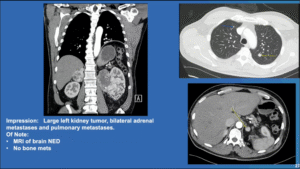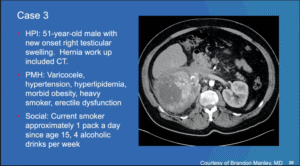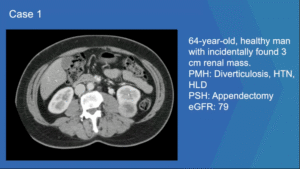


In this second tumor board case, Dr. Mark Ball of the National Cancer Institute leads a multidisciplinary discussion on the evaluation and management of a 45-year-old patient with bilateral renal masses. Joined by Dr. Brandon Manley (urologic oncology, Moffitt Cancer Center), Dr. Raki Hannan (radiation oncology, UT Southwestern), and Dr. Rena McKay (GU medical oncology, UC San Diego), the panel walks through diagnostic considerations, treatment planning, and long-term surveillance for this complex presentation.
The team reviews candidacy for SBRT in the setting of bilateral, centrally located masses; the role of germline genetic testing and renal mass biopsy; and how histology—here, papillary type 1 RCC—shapes management. They discuss surgical decision-making for staged partial nephrectomies, postoperative surveillance, and the evaluation of late nodal recurrence discovered a decade later. The conversation also examines the role of systemic therapy, clinical trial options, and whether retroperitoneal lymph node dissection (RPLND) or SBRT is appropriate for isolated retroperitoneal disease.
Contributors:

Dr. Mark Ball is an attending surgeon at the Urologic Oncology Branch of the National Cancer Institute and Associate Program Director of the Urologic Oncology Fellowship Program in Bethesda, Maryland.

Dr. Raquibul Hannan is the chief of the genitourinary radiation oncology service at UT Southwestern in Dallas, Texas.

Dr. Brandon Manley is a urologic oncologist at Moffitt Cancer Center in Tampa, Florida.

Dr. Rana McKay is a medical oncologist and associate professor at UC San Diego Health in California.