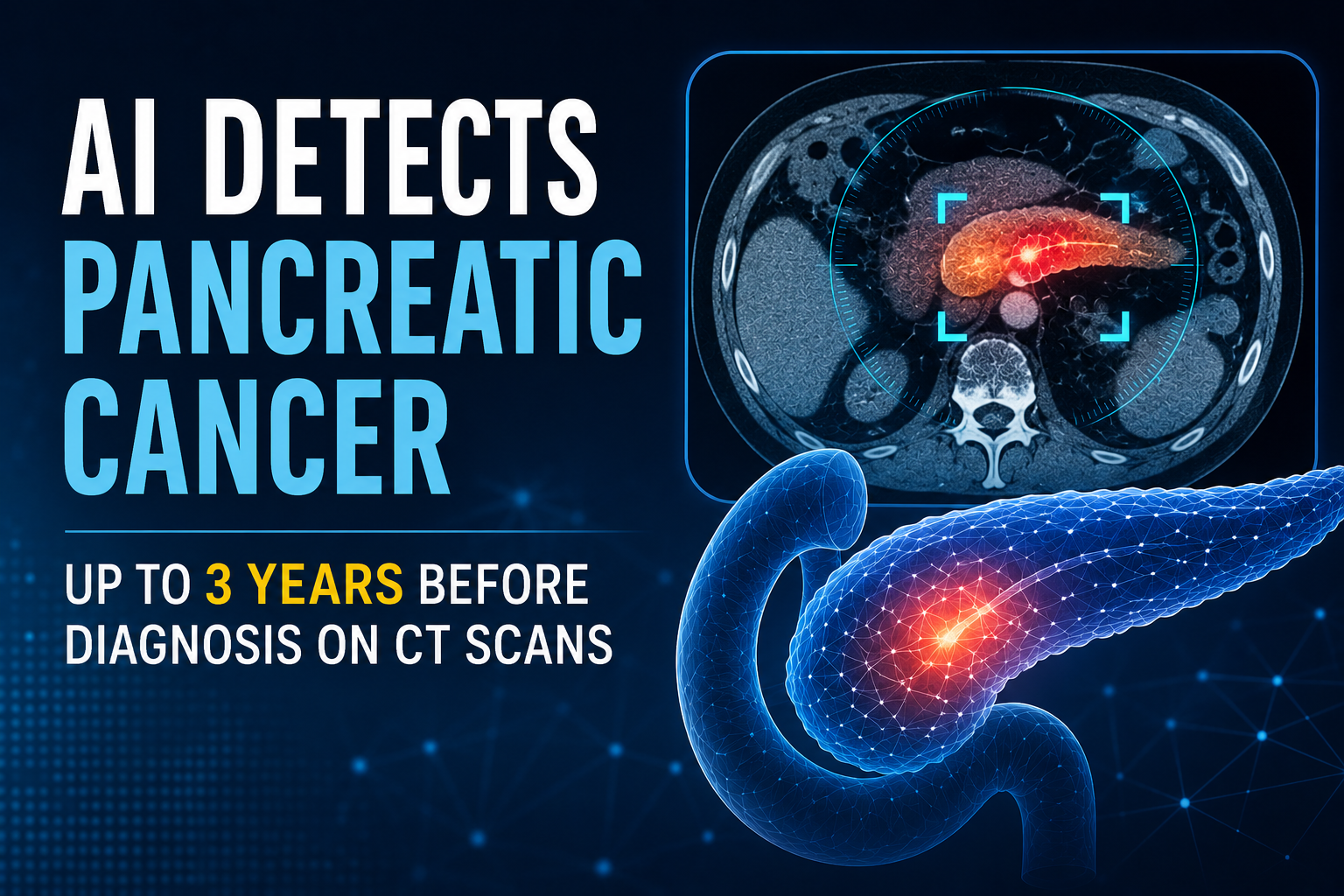
A breakthrough artificial intelligence system has demonstrated the ability to detect pancreatic ductal adenocarcinoma (PDAC) up to 3 years before clinical diagnosis, achieving significantly higher accuracy than expert radiologists in identifying visually occult disease on standard CT scans.
Clinical Takeaway
The Radiomics-based Early Detection MODel (REDMOD) achieved 73.0% sensitivity for detecting pre-diagnostic pancreatic cancer at a median lead time of 475 days, nearly doubling the performance of radiologists (38.9% sensitivity). This fully automated AI framework addresses the critical clinical challenge of identifying pancreatic cancer during its curable, pre-symptomatic phase when conventional imaging appears normal.
Technology Profile & Mechanism
REDMOD combines AI-driven pancreas segmentation with advanced radiomic analysis to identify subtle textural changes in pancreatic tissue that precede visible tumor formation. The system processes 968 quantitative features from standard CT scans, using machine learning algorithms to detect microscopic architectural disruptions invisible to human interpretation.
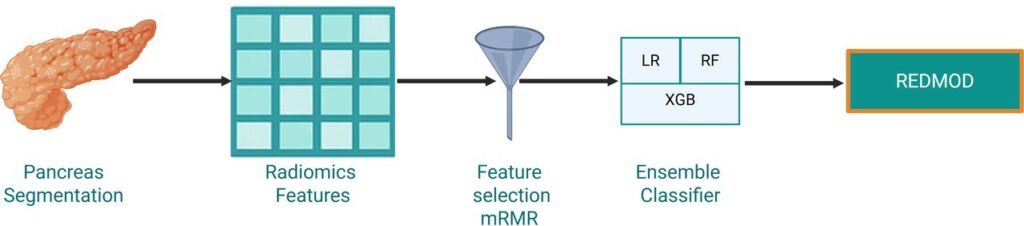
- Automated segmentation: 3D nnU-Net architecture for precise pancreas delineation
- Feature extraction: Multi-scale wavelet and Laplacian-of-Gaussian filtering
- Classification: Ensemble model combining logistic regression, random forest, and XGBoost
- Key insight: 90% of predictive features derived from filtered texture analysis
Study Design & Population
This multi-institutional validation study analyzed 1,462 CT scans from patients with pre-diagnostic pancreatic cancer and matched controls, simulating real-world early detection scenarios with a clinically realistic 6:1 control-to-case ratio.
- Training cohort: 969 scans (156 pre-diagnostic, 813 control)
- Test cohort: 493 scans (63 pre-diagnostic, 430 control)
- Multi-institutional: 70% external hospital scans
- Lead time range: 3-36 months before clinical diagnosis
- Validation criteria: All scans were prospectively read as normal by radiologists
Performance Outcomes
REDMOD demonstrated superior performance across multiple validation metrics compared to expert radiologist interpretation:
- Primary endpoint:
- AUC: 0.82 (95% CI: 0.81-0.83)
- Sensitivity: 73.0% vs radiologists’ 38.9% (p<0.001)
- Specificity: 81.1%
- Lead time performance:
- 3-12 months: 75.0% sensitivity
- 12-24 months: 75.0% sensitivity
- >24 months: 68.4% sensitivity (3-fold higher than radiologists)
- External validation:
- Multi-institutional cohort: 81.3% specificity (n=539)
- Public NIH dataset: 87.5% specificity (n=80)
Longitudinal Stability
A critical validation demonstrated REDMOD’s consistency across serial imaging studies, essential for clinical reliability:
- Test-retest concordance: 90-92% across temporal scans
- Control cohort: 92% consistency for true negatives
- Pre-diagnostic cohort: 90% maintained true positive classification
- Signal persistence: Detectable signature maintained 12-24 months
Key Clinical Implications
✔ Early detection capability: REDMOD identifies pancreatic cancer signatures when tumors are still invisible and potentially curable, addressing the primary barrier to improved survival
✔ Clinical workflow integration: Fully automated system processes standard-of-care CT scans without additional imaging requirements or manual interpretation steps
✔ Risk stratification tool: Could enhance NICE guideline implementation for high-risk patients with new-onset diabetes and weight loss
✔ Flexible threshold design: Adjustable sensitivity-specificity balance without retraining enables clinical customization for different risk contexts
✔ Observe-and-retest strategy: High longitudinal stability supports serial monitoring approach for intermediate-risk results
Future Directions
The research team is advancing toward prospective clinical validation through the AI-PACED trial, which will evaluate REDMOD in high-risk patient cohorts. Future applications may include integration with molecular imaging techniques and emerging systemic interception therapies that could treat early-stage disease without requiring precise lesion localization.
Bottom Line
REDMOD represents a significant advancement in pancreatic cancer early detection, demonstrating the potential to shift diagnosis from late-stage symptomatic presentation to pre-clinical interception. With nearly double the sensitivity of radiologists and robust performance across diverse clinical settings, this AI framework provides a scalable foundation for improving outcomes in one of oncology’s most challenging malignancies. Prospective validation in high-risk populations represents the critical next step toward clinical implementation.
Sources:
- Mukherjee S, Antony A, Patnam NG, et al. Next-generation AI for visually occult pancreatic cancer detection in a low-prevalence setting with longitudinal stability and multi-institutional generalisability. Gut. Published online April 28, 2026. doi:10.1136/gutjnl-2025-337266