
Results from the global Phase III SAFFRON trial demonstrate that the combination of osimertinib (Tagrisso) plus savolitinib (Orpathys) confers statistically significant and clinically meaningful improvements in both progression-free survival (PFS) and overall survival (OS) versus doublet platinum-based chemotherapy in patients with EGFRm NSCLC harbouring high-level MET overexpression or amplification following disease progression on prior osimertinib.1 These are the first global Phase III data to demonstrate significant PFS and OS benefits in this treatment setting, and they reinforce osimertinib as the backbone of therapy across EGFRm lung cancer.1
Clinical Takeaway
The SAFFRON Phase III trial establishes osimertinib + savolitinib as the first biomarker-directed, all-oral treatment strategy to demonstrate significant PFS and OS benefit over platinum-based doublet chemotherapy in patients with MET-driven resistance to third-generation EGFR-TKI therapy. These results support the urgent integration of MET testing into routine clinical practice following osimertinib progression and have been shared with global regulatory authorities in support of worldwide registration.
Drug Profile & Mechanism
- Osimertinib (Tagrisso): A third-generation, oral EGFR-tyrosine kinase inhibitor (TKI) that irreversibly inhibits EGFR-activating mutations and the T790M resistance mutation; provides established CNS penetration and protection.
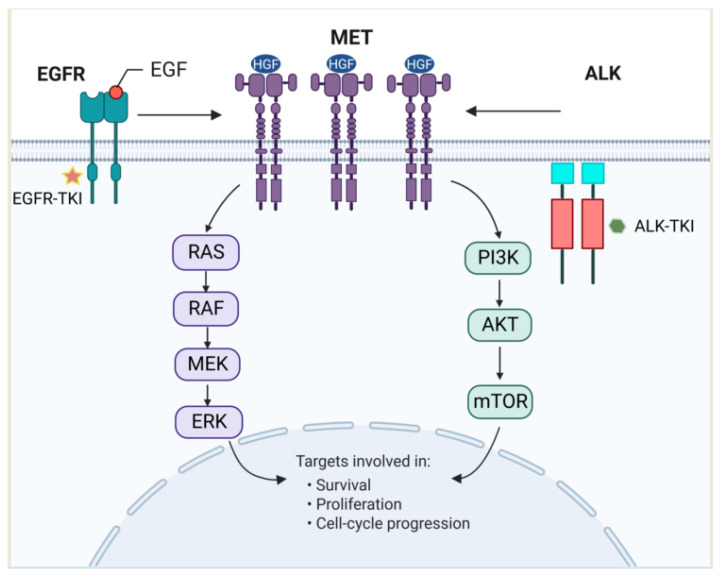
- Savolitinib (Orpathys): An oral, potent, and selective MET-TKI designed to inhibit aberrant MET signalling driven by MET overexpression or amplification, one of the most common mechanisms of acquired resistance to third-generation EGFR-TKIs.
- Rationale for combination: MET activation can bypass EGFR suppression; combining savolitinib with continued osimertinib simultaneously targets both the EGFR pathway and the MET-driven escape mechanism, maintaining dual oncogenic pathway suppression.
- Development & approvals: Orpathys is co-developed by AstraZeneca and HUTCHMED. The combination of osimertinib + savolitinib is currently approved in China for locally advanced or metastatic EGFRm NSCLC with MET amplification after EGFR-TKI progression, based on the SACHI Phase III trial.
Target Population & Disease Context
- Lung cancer is the leading cause of cancer death globally, accounting for approximately 23% of all cancer deaths.2
- 80–85% of lung cancer diagnoses are NSCLC, with approximately 75% presenting with advanced disease.3,4
- EGFRm NSCLC affects approximately 10–15% of patients in the US and Europe, and 30–40% in Asia.5,6
- An estimated 34% of tumours will develop high-level MET overexpression or amplification following progression on a third-generation EGFR-TKI — making it one of the most common acquired resistance mechanisms.7
- MET-driven resistance is associated with poor prognosis and, prior to these data, no biomarker-directed, oral treatment options were available in the post-osimertinib setting.8
Study Design
- Trial name: SAFFRON (NCT05261399)
- Phase: Phase III
- Design: Randomised, open-label, multi-centre, global
- Sample size: 338 patients
- Sites: 230 centres across 29 countries, including North America, Europe, South America, and Asia
- Experimental arm: Savolitinib 300 mg twice daily + osimertinib 80 mg once daily
- Control arm: Doublet platinum-based chemotherapy
- Eligible patients: Adults with locally advanced or metastatic EGFRm NSCLC with high-level MET overexpression or amplification whose disease progressed following 1st- or 2nd-line treatment with osimertinib
- Patient selection methodology: Patients were prospectively selected using high MET level cut-offs identified in the SAVANNAH Phase II trial. Two validated tests determined MET status:
- Immunohistochemistry (IHC): detects MET protein overexpression on cancer cell surfaces
- Fluorescence in situ hybridisation (FISH): detects MET gene amplification at the DNA level
Endpoints
- Primary endpoint: Progression-free survival (PFS)
- Key secondary endpoints:
- Overall survival (OS)
- Objective response rate (ORR)
Efficacy Outcomes
- PFS: Osimertinib + savolitinib demonstrated a statistically significant and clinically meaningful improvement in PFS compared with doublet platinum-based chemotherapy.
- OS: The combination also demonstrated a statistically significant and clinically meaningful improvement in OS versus chemotherapy — a particularly notable outcome given the historically poor prognosis associated with MET-driven resistance.
- SAFFRON is the first global Phase III trial to demonstrate significant improvements in both PFS and OS in patients with EGFRm NSCLC and MET-driven resistance following osimertinib.
- These global results are consistent with the SACHI Phase III trial, which previously supported approval of the combination in China, reinforcing the robustness of the efficacy signal across international populations.
- Specific numerical data for PFS, OS, and ORR will be presented at a forthcoming medical meeting.
Safety
- The safety profile of osimertinib plus savolitinib in SAFFRON was consistent with the known individual profiles of each agent.
- No new safety signals were identified.
- Detailed safety data will be disclosed at a forthcoming medical meeting.
Key Clinical Implications
✔ MET testing at osimertinib progression is now critically important. With approximately one in three patients developing high-level MET overexpression or amplification, systematic biomarker evaluation using IHC and FISH should be integrated into standard post-progression workup to identify candidates for targeted therapy.
✔ Osimertinib + savolitinib represents a potential new standard of care in MET-driven EGFRm NSCLC. SAFFRON is the first Phase III trial globally to demonstrate significant PFS and OS improvements over platinum-based chemotherapy in this biomarker-selected population, establishing a strong efficacy and safety rationale for regulatory submissions worldwide.
✔ The all-oral, well-tolerated regimen offers a meaningful advantage over chemotherapy. For patients who have already been exposed to osimertinib, the prospect of continuing an oral regimen with a favourable toxicity profile — rather than transitioning to intravenous platinum doublet chemotherapy — has significant quality-of-life implications.
✔ Osimertinib’s role as the foundational backbone therapy in EGFRm NSCLC is further reinforced. The SAFFRON data support a strategy in which osimertinib is maintained across lines of therapy, with targeted agents added sequentially to address specific mechanisms of acquired resistance as they emerge.
✔ Global regulatory submissions are anticipated. These data have been shared with global regulatory authorities; international approvals could extend access to this combination beyond its current China-approved indication.
Bottom Line
The SAFFRON Phase III trial provides the first global evidence that osimertinib plus savolitinib significantly improves both PFS and OS over platinum-based doublet chemotherapy in patients with EGFRm NSCLC and high-level MET overexpression or amplification following prior osimertinib. With a consistent safety profile, an all-oral administration route, and prospective biomarker-driven patient selection, this combination has the potential to become the first globally approved, targeted treatment option in this high-unmet-need population. Oncologists should prioritise MET biomarker testing at the time of osimertinib progression to ensure eligible patients can benefit from this approach as regulatory decisions unfold.
Sources
Sources:
- AstraZeneca. (2026). Tagrisso plus Orpathys demonstrated statistically significant and clinically meaningful improvements in progression-free and overall survival in MET-driven EGFR-mutated lung cancer after progression on Tagrisso. AstraZeneca Press Release, 17 August 2026. https://www.astrazeneca.com/media-centre/press-releases/2026/tagrisso-orpathys-improved-pfs-os-egfrm-lung.html
- World Health Organization. International Agency for Research on Cancer. Lung Fact Sheet. Available at: https://gco.iarc.who.int/media/globocan/factsheets/cancers/15-trachea-bronchus-and-lung-fact-sheet.pdf. Accessed August 2026
- American Cancer Society. What Is Lung Cancer? Available at: https://www.cancer.org/cancer/types/lung-cancer/about/what-is.html. Accessed August 2026
- Chen HJ, et al. Long-term survival of advanced lung adenocarcinoma by maintenance chemotherapy followed by EGFR-TKI. Medicine. 2021;100(6):e24688
- Keedy VL, et al. American Society of Clinical Oncology Provisional Clinical Opinion: Epidermal Growth Factor Receptor (EGFR) Mutation Testing for Patients with Advanced Non-Small-Cell Lung Cancer Considering First- Line EGFR Tyrosine Kinase Inhibitor Therapy. J Clin Oncol. 2011;29:2121-2127
- Ellison G, et al. EGFR Mutation Testing in Lung Cancer: a Review of Available Methods and Their Use for Analysis of Tumour Tissue and Cytology Samples. J Clin Pathol. 2013;66:79-89
- De Marinis F, et al. Savolitinib plus osimertinib in epidermal growth factor receptor (EGFR)-mutated advanced non-small cell lung cancer with MET overexpression and/or amplification following disease progression on osimertinib: primary results from the phase II SAVANNAH study. Ann Oncol. 2025;36(8):920-933
- Wang Q, et al. MET inhibitors for targeted therapy of EGFR TKI-resistant lung cancer. J Hematol Oncol. 2019;63