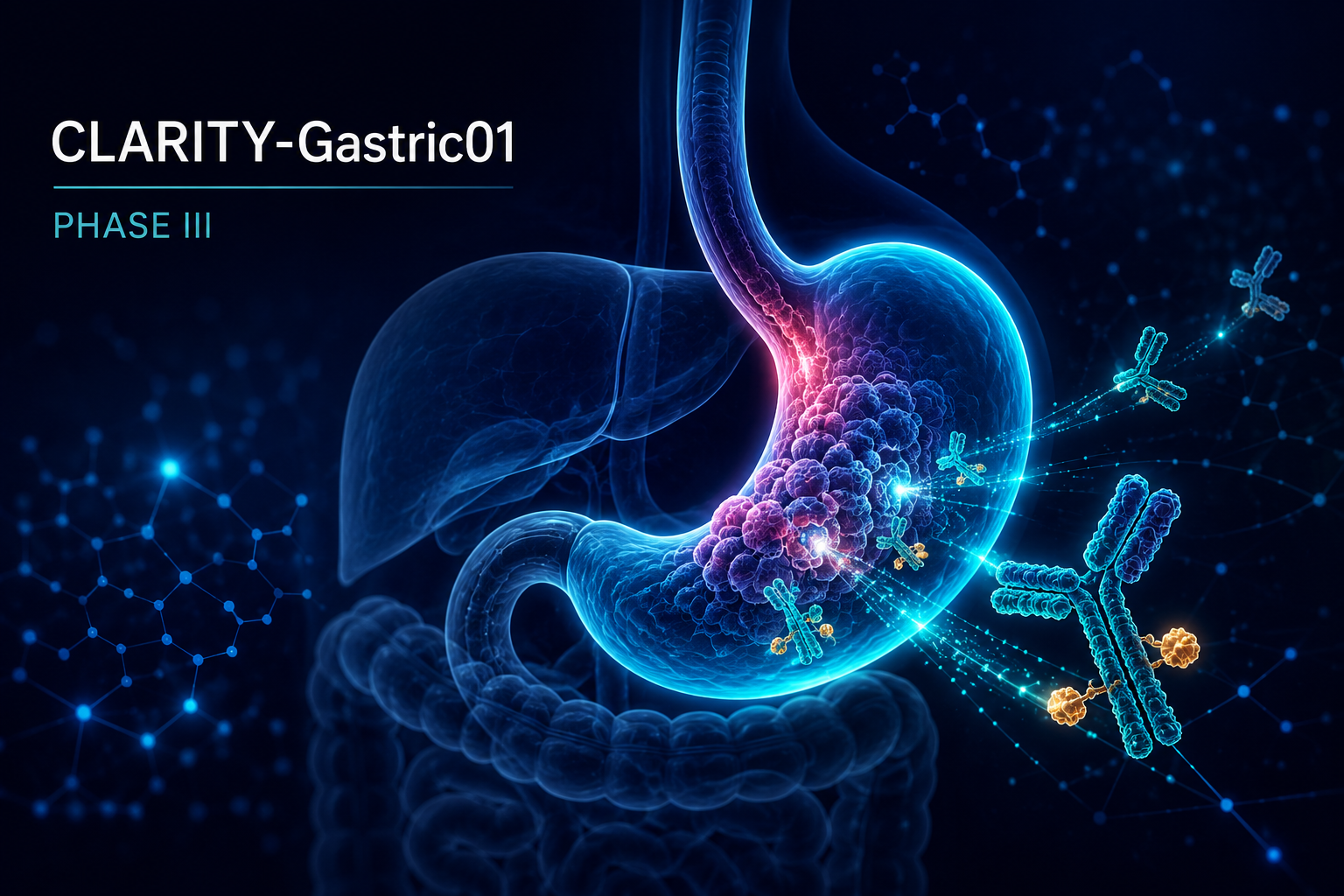
Results from the global Phase III CLARITY-Gastric01 trial show that sonesitatug vedotin (Sone-Ve), a first-in-class CLDN18.2-targeting antibody-drug conjugate (ADC), delivered a statistically significant and highly clinically meaningful improvement in overall survival (OS) in patients with 2nd and later-line CLDN18.2-positive advanced gastric, gastroesophageal junction (GEJ), or esophageal adenocarcinoma (EAC), representing the first reported Phase III OS benefit demonstrated with an anti-CLDN18.2 ADC in this setting.
Clinical Takeaway
Sone-Ve is the first CLDN18.2-targeted ADC to demonstrate an overall survival benefit in previously treated advanced gastric/GEJ cancers in a Phase III setting. The trial’s OS results were met in both the 3rd and later-line primary endpoint and the 2nd and later-line key secondary endpoint, supporting the potential to broaden the eligible patient population to those with CLDN18.2 expression in ≥25% of tumour cells — encompassing approximately 60% of patients in this setting.
Drug Profile & Mechanism
- Drug name: Sonesitatug vedotin (Sone-Ve)
- Drug class: Antibody-drug conjugate (ADC)
- Target: Claudin 18.2 (CLDN18.2), a tight junction protein aberrantly expressed on the surface of gastric and GEJ tumour cells
- Payload: Monomethyl auristatin E (MMAE), a potent microtubule-disrupting cytotoxic agent
- Developer: AstraZeneca (wholly owned ADC asset; first pivotal readout from this portfolio)
- Regulatory designations:
- Orphan Drug Designation from the US FDA and European Commission for gastric and GEJ cancers
- Breakthrough Designation in China for 2nd-line gastric cancer treatment
Target Population
- Patients with locally advanced or metastatic gastric cancer, GEJ cancer, or oesophageal adenocarcinoma (EAC) with CLDN18.2 expression in ≥25% of tumour cells at any staining intensity
- Patients receiving treatment in the 2nd and later-line setting
- Estimated ~183,500 patients per year in the US, EU, China, and Japan are treated in the 2nd and later-line setting for advanced or metastatic CLDN18.2-positive, non-HER2-positive gastric/GEJ cancers
- Approximately 60% of gastric/GEJ cancers express CLDN18.2 in ≥25% of tumour cells, representing a substantial addressable population
- Prognosis in this setting is poor: fewer than 20% of patients survive beyond one year, and median survival with 2nd and later-line systemic treatment is approximately 5–9 months
Study Design
- Trial name: CLARITY-Gastric01
- Phase: III
- Design: Randomised, open-label, sponsor-blinded, multicentre, global
- Setting: 175 centres across 19 countries (North America, Europe, South America, and Asia)
- Indication: 2nd and later-line treatment of advanced or metastatic gastric cancer, GEJ cancer, or EAC with CLDN18.2 IHC+ expression in ≥25% of tumour cells at any intensity
- Treatment arms:
- Stage 1 (dose selection): Patients randomised 1:1:1 to Sone-Ve 2.2 mg/kg Q3W, Sone-Ve 1.8 mg/kg Q3W, or investigator’s choice of therapy (comparator arm)
- Stage 2: Continued with Sone-Ve 2.2 mg/kg Q3W as the recommended Phase III dose
- Efficacy analyses will also inform validation of the Ventana SP455 assay for CLDN18.2 patient identification
Endpoints
- Dual primary endpoints:
- Overall survival (OS) in patients treated in the 3rd and later-line setting
- Progression-free survival (PFS) as assessed by blinded independent central review (BICR) in the overall 2nd and later-line population
- Key secondary endpoint: OS in the overall 2nd and later-line population
Efficacy Outcomes
- OS — 3rd and later-line (dual primary endpoint): MET — Sone-Ve demonstrated a statistically significant and highly clinically meaningful improvement in OS versus investigator’s choice of therapy
- OS — 2nd and later-line overall population (key secondary endpoint): MET — A statistically significant and highly clinically meaningful OS improvement was also observed in the broader 2nd and later-line population
- PFS — 2nd and later-line overall population (dual primary endpoint): NOT MET — Results showed a trend toward improved PFS by BICR, but did not reach statistical significance
- These results represent the first reported Phase III trial to demonstrate OS benefit with an anti-CLDN18.2 ADC in previously treated gastric/GEJ cancers
Safety
- Sone-Ve was reported to be well tolerated in CLARITY-Gastric01
- The safety profile was consistent with the previously established profile of Sone-Ve
- No new safety signals were identified
- Full safety data will be presented at a forthcoming medical meeting
Key Clinical Implications
✔ First Phase III OS benefit for a CLDN18.2-targeted ADC: CLARITY-Gastric01 establishes Sone-Ve as a potentially practice-changing option in a setting with historically poor outcomes and limited therapeutic advances.
✔ Broader patient eligibility: The use of a ≥25% CLDN18.2 expression threshold at any staining intensity — rather than higher cut-offs used in prior trials — could extend precision treatment access to approximately 60% of patients with advanced gastric/GEJ cancers.
✔ Companion diagnostics development: Validation of the Ventana SP455 assay for CLDN18.2 detection within the trial framework signals a pathway toward standardised biomarker-driven patient selection in clinical practice.
✔ Regulatory pathway underway: Data are being shared with global regulatory authorities. Combined with existing Orphan Drug Designation (US and EU) and Breakthrough Designation (China), Sone-Ve is positioned for expedited regulatory review across key markets.
✔ Potential chemotherapy alternative: Sone-Ve’s mechanism — targeted CLDN18.2 binding with MMAE-mediated cytotoxicity — offers a rationale for substituting conventional chemotherapy in CLDN18.2-positive patients, potentially improving the therapeutic index in later-line treatment.
Bottom Line
The CLARITY-Gastric01 Phase III trial marks a significant milestone in the treatment of advanced gastric and GEJ cancers. Sonesitatug vedotin (Sone-Ve) is the first CLDN18.2-targeting ADC to achieve an overall survival benefit in the 2nd and later-line setting, meeting both its 3rd-line primary OS endpoint and the broader 2nd and later-line key secondary OS endpoint. Although the PFS co-primary endpoint did not reach statistical significance, the OS signal across multiple analyses is clinically compelling. With its favorable safety profile, broad patient eligibility criteria, and accelerated regulatory designations, Sone-Ve has the potential to redefine precision oncology approaches in CLDN18.2-positive gastric, GEJ, and oesophageal adenocarcinoma. Full data are anticipated at an upcoming medical conference.
Sources
Sources:
- AstraZeneca. Sonesitatug vedotin (Sone-Ve) demonstrated a statistically significant and highly clinically meaningful improvement in overall survival in 2nd and later-line CLDN18.2-positive advanced gastric/GEJ cancers. Published July 27, 2026. https://www.astrazeneca.com/media-centre/press-releases/2026/sone-ve-improved-survival-in-gastric-cancers.html