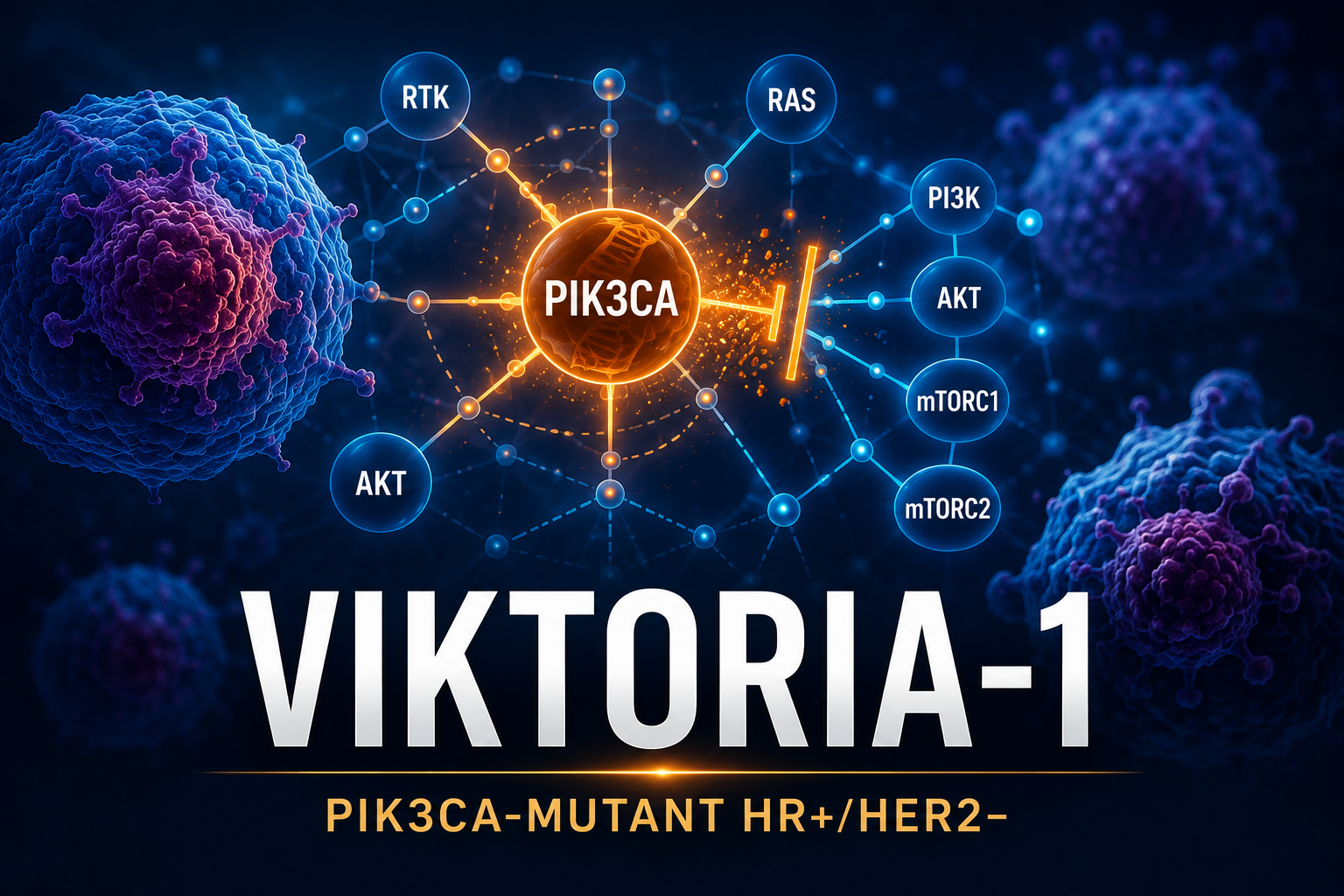
New results from the phase 3 VIKTORIA-1 trial demonstrate that gedatolisib combinations prolonged median progression-free survival by 5.5 to 5.7 months compared with alpelisib plus fulvestrant in patients with PIK3CA-mutant HR-positive, HER2-negative advanced breast cancer following prior CDK4/6 inhibitor treatment. These findings complement earlier VIKTORIA-1 results showing similar benefits in PIK3CA wild-type disease, positioning gedatolisib as a potential new treatment option despite its intravenous administration requirements.
Clinical Takeaway
The VIKTORIA-1 trial provides the first phase 3 randomized evidence that comprehensive PI3K/AKT/mTOR pathway inhibition with gedatolisib improves outcomes compared with single-node targeting approaches. Both the gedatolisib triplet (gedatolisib, palbociclib, fulvestrant) and doublet (gedatolisib plus fulvestrant) showed superior efficacy to alpelisib plus fulvestrant, with higher response rates, lower rates of hyperglycemia and diarrhea, and fewer treatment-related discontinuations, although stomatitis was more common with gedatolisib-based therapy. However, the intravenous administration requirement may limit adoption in earlier treatment lines.
Drug Profile & Mechanism
Gedatolisib was designed to achieve more comprehensive pathway blockade than currently available PI3K/AKT/mTOR inhibitors by targeting multiple levels simultaneously:
- Inhibits all 4 class I PI3K isoforms alongside mTORC1 and mTORC2
- Activity independent of PIK3CA mutation status, offering utility across both mutated and wild-type disease
- Addresses adaptive resistance triggered by compensatory activation of other PI3K isoforms or mTOR complexes seen with single-target agents
Current PI3K/AKT/mTOR pathway inhibitors—alpelisib, inavolisib, capivasertib, and everolimus—each target only a single level within the pathway, potentially limiting their long-term efficacy.
Target Population
The PIK3CA-mutant cohort of VIKTORIA-1 enrolled patients with:
- PIK3CA-mutant HR-positive, HER2-negative advanced breast cancer
- Prior treatment with CDK4/6 inhibitor plus aromatase inhibitor for advanced disease
- No prior chemotherapy for advanced disease
Study Design & Endpoints
VIKTORIA-1 is a phase 3 randomized trial that evaluated gedatolisib combinations in two prespecified cohorts based on PIK3CA mutation status. The PIK3CA-mutant cohort compared:
- Primary endpoint: Gedatolisib triplet vs alpelisib plus fulvestrant
- Key secondary endpoint: Gedatolisib doublet vs alpelisib plus fulvestrant
- Primary efficacy measure: Progression-free survival assessed by blinded independent central review
Efficacy Outcomes
The PIK3CA-mutant cohort results demonstrated statistically significant and clinically meaningful improvements in progression-free survival:
- Gedatolisib Triplet vs Alpelisib + Fulvestrant:
- Median PFS: 11.1 vs 5.6 months
- Hazard ratio: 0.50 (95% CI 0.37-0.68; P < 0.0001)
- PFS improvement: 5.5 months
- Gedatolisib Doublet vs Alpelisib + Fulvestrant:
- Median PFS: 11.3 vs 5.6 months
- Hazard ratio: 0.51 (95% CI 0.33-0.79; P = 0.0013)
- PFS improvement: 5.7 months
Secondary efficacy measures also favored gedatolisib combinations:
- Objective response rates: 48.9% (triplet), 35.7% (doublet), 26.0% (alpelisib + fulvestrant)
- Median duration of response: 15.7, 24.2, and 7.5 months, respectively
- Overall survival data remain immature
Safety Profile
The safety profile generally favored gedatolisib combinations over alpelisib plus fulvestrant, with notable reductions in problematic PI3K inhibitor-associated toxicities:
- Any-grade hyperglycemia: 15.0% (triplet) vs 11.5% (doublet) vs 57.9% (alpelisib + fulvestrant)
- Any-grade diarrhea: 15.0% vs 9.6% vs 40.1%, respectively
- Treatment discontinuation due to adverse events: 2.6% vs 3.8% vs 7.1%, respectively
However, stomatitis occurred more frequently with gedatolisib-based therapy:
- Any-grade stomatitis: 61.4% (triplet) vs 61.5% (doublet) vs 34.2% (alpelisib + fulvestrant)
Key Clinical Implications
✔ First phase 3 evidence demonstrating superiority of comprehensive PI3K/AKT/mTOR pathway inhibition over single-node targeting in PIK3CA-mutant breast cancer
✔ Gedatolisib doublet shows particularly promising activity with a favorable benefit-risk profile compared to current standard alpelisib plus fulvestrant
✔ Intravenous administration requirement may limit widespread adoption, particularly in earlier treatment lines where patient preference favors oral therapies
✔ Treatment sequencing questions remain: optimal positioning relative to oral PI3K inhibitors requires further study and individualized clinical judgment
✔ Shared decision-making essential to balance efficacy benefits against administration burden and patient preferences for convenience
Regulatory Status
Gedatolisib is currently under priority review by the U.S. Food and Drug Administration:
- PIK3CA wild-type disease: Gedatolisib is under FDA priority review, with a target action date expected in midsummer 2026
- PIK3CA-mutated disease: Review is expected to take longer, with a potential decision anticipated in early 2027
Bottom Line
VIKTORIA-1 establishes gedatolisib combinations as highly active regimens for PIK3CA-mutant HR-positive, HER2-negative advanced breast cancer following CDK4/6 inhibitor progression. The 5.5-5.7 month PFS improvement over alpelisib plus fulvestrant, combined with favorable tolerability, lower rates of hyperglycemia and diarrhea, and improved response rates, supports gedatolisib as an important new treatment option. However, the intravenous administration requirement and unanswered questions about optimal treatment sequencing will require careful consideration in clinical practice, emphasizing the need for individualized patient discussions balancing efficacy against convenience and quality of life preferences.
Sources:
- Nyberg K. VIKTORIA-1: gedatolisib combinations prolong PFS in HR-positive, HER2-negative, PIK3CA-mutant advanced breast cancer. ASCO Daily News. Published June 2, 2026. Accessed June 12, 2026. https://dailynews.ascopubs.org/do/viktoria-1-gedatolisib-combinations-prolong-pfs-advanced-breast-cancer