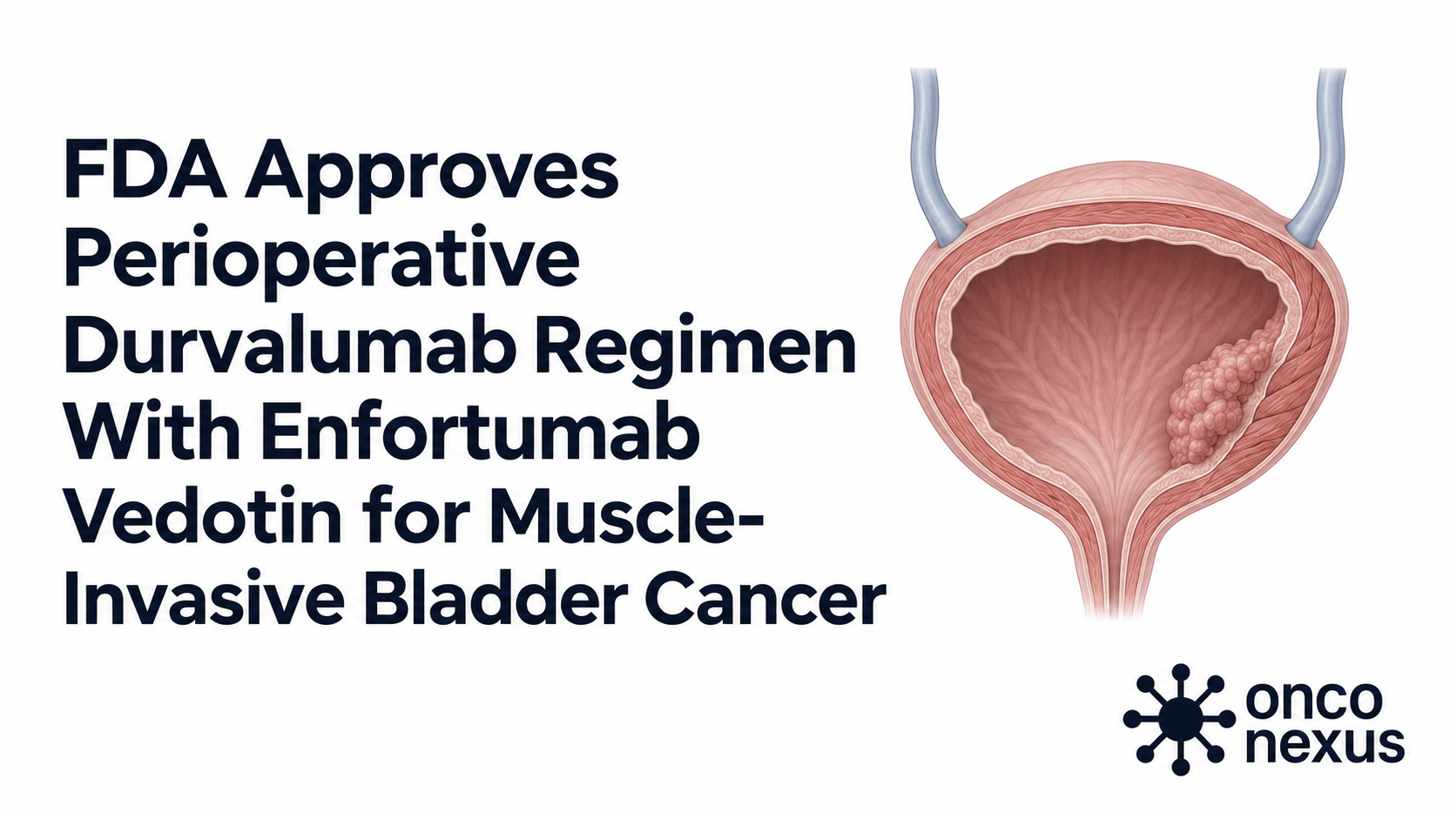
The US Food and Drug Administration on November 13, 2026, approved durvalumab (Imfinzi, AstraZeneca) in combination with enfortumab vedotin-ejfv as neoadjuvant treatment, followed by single-agent durvalumab as adjuvant treatment after radical cystectomy, for adult patients with muscle-invasive bladder cancer (MIBC) who are ineligible for or who have refused cisplatin-based chemotherapy.
The approval was supported by the phase 3 VOLGA trial, which showed statistically significant improvements in event-free survival (EFS) and overall survival (OS) compared with a control arm in which patients were assigned to radical cystectomy with observation or locally approved adjuvant treatment.
Key finding
In VOLGA, durvalumab plus neoadjuvant enfortumab vedotin-ejfv lowered the hazard of an EFS event by 49% (HR, 0.51) and the hazard of death by 42% (HR, 0.58) versus the control arm. Estimated 24-month OS was 78.4% versus 69.4%, a difference of 9 percentage points. Median OS was not reached in either arm.
Study Design
| Trial | VOLGA (NCT04960709), a randomized, open-label, three-arm phase 3 trial |
|---|---|
| Population | 695 adults with MIBC who were candidates for radical cystectomy and were ineligible for or declined cisplatin-based chemotherapy |
| Treatment | Patients were randomized 1:1:1 to the approved regimen, a separate investigational regimen that included tremelimumab, or the control arm. The approved regimen consisted of three cycles of neoadjuvant durvalumab plus enfortumab vedotin-ejfv, followed by radical cystectomy and up to nine cycles of adjuvant durvalumab alone. The control arm was assigned to radical cystectomy with observation or locally approved adjuvant treatment. |
| Primary endpoint | EFS by blinded independent central review for each investigational regimen versus the control arm |
| Key secondary endpoints | Overall survival (OS |
Results and Safety
Median EFS was not reached (95% CI, 33.2 months to not reached) with the approved regimen and was 12.1 months (95% CI, 7.6–27.0) in the control arm (HR, 0.51 [95% CI, 0.38–0.67], P < .0001). Median OS was not reached in either arm. The hazard ratio for death was 0.58 (95% CI, 0.40–0.83, P = .0027).
The durvalumab prescribing information carries warnings and precautions for immune-mediated adverse reactions, infusion-related reactions, complications of allogeneic hematopoietic stem cell transplantation, and embryo-fetal toxicities. Adverse reactions occurring in more than 20% of patients receiving durvalumab in combination with enfortumab vedotin-ejfv — including laboratory abnormalities — included increased AST and ALT, decreased hemoglobin, rash, increased creatinine, pruritus, decreased calcium, increased lipase, increased potassium, urinary tract infection, increased amylase, fatigue, decreased sodium, decreased lymphocytes, diarrhea, decreased leukocytes, constipation, decreased appetite, increased alkaline phosphatase, dysgeusia, nausea, peripheral neuropathy, musculoskeletal pain, and alopecia. In the published VOLGA report, grade 3 or higher adverse events of any cause occurred in 71.1% of patients in the durvalumab plus enfortumab vedotin group and 50.2% in the control group. Grade 3 or higher treatment-related adverse events occurred in 30.7% of patients in the durvalumab plus enfortumab vedotin group.
Clinical Context
The approval adds a perioperative option for patients with MIBC who are ineligible for or decline cisplatin-based chemotherapy. The FDA first approved perioperative pembrolizumab plus enfortumab vedotin-ejfv for cisplatin-ineligible adults in November 2025 and broadened the indication in July 2026. The pembrolizumab regimen includes enfortumab vedotin-ejfv both before and after cystectomy. The durvalumab regimen uses enfortumab vedotin-ejfv only before surgery, followed by durvalumab alone after surgery.
Longer follow-up will help clarify the durability of the overall survival benefit. How the durvalumab regimen compares with other approved perioperative regimens remains an open question.
The FDA conducted the review under Project Orbis in collaboration with regulators in Australia, Brazil, Canada, Israel, Singapore, and the United Kingdom. The agency said applications in those jurisdictions may still be in submission or under review.
Sources
- U.S. Food and Drug Administration. “FDA Approves Durvalumab + Enfortumab Vedotin-ejfv for Muscle-Invasive Bladder Cancer.” Regulatory announcement. November 13, 2026. View source.
- Powles T, Grande E, Simone G, et al. Durvalumab, tremelimumab, and enfortumab vedotin in muscle-invasive bladder cancer. N Engl J Med. Published online October 24, 2026. VOLGA trial publication
- European Association of Urology. Phase 3 VOLGA trial results presented at ESMO 2026. View trial summary
- US Food and Drug Administration. Pembrolizumab plus enfortumab vedotin-ejfv approvals in muscle-invasive bladder cancer. November 2025 approval and July 2026 expanded approval.