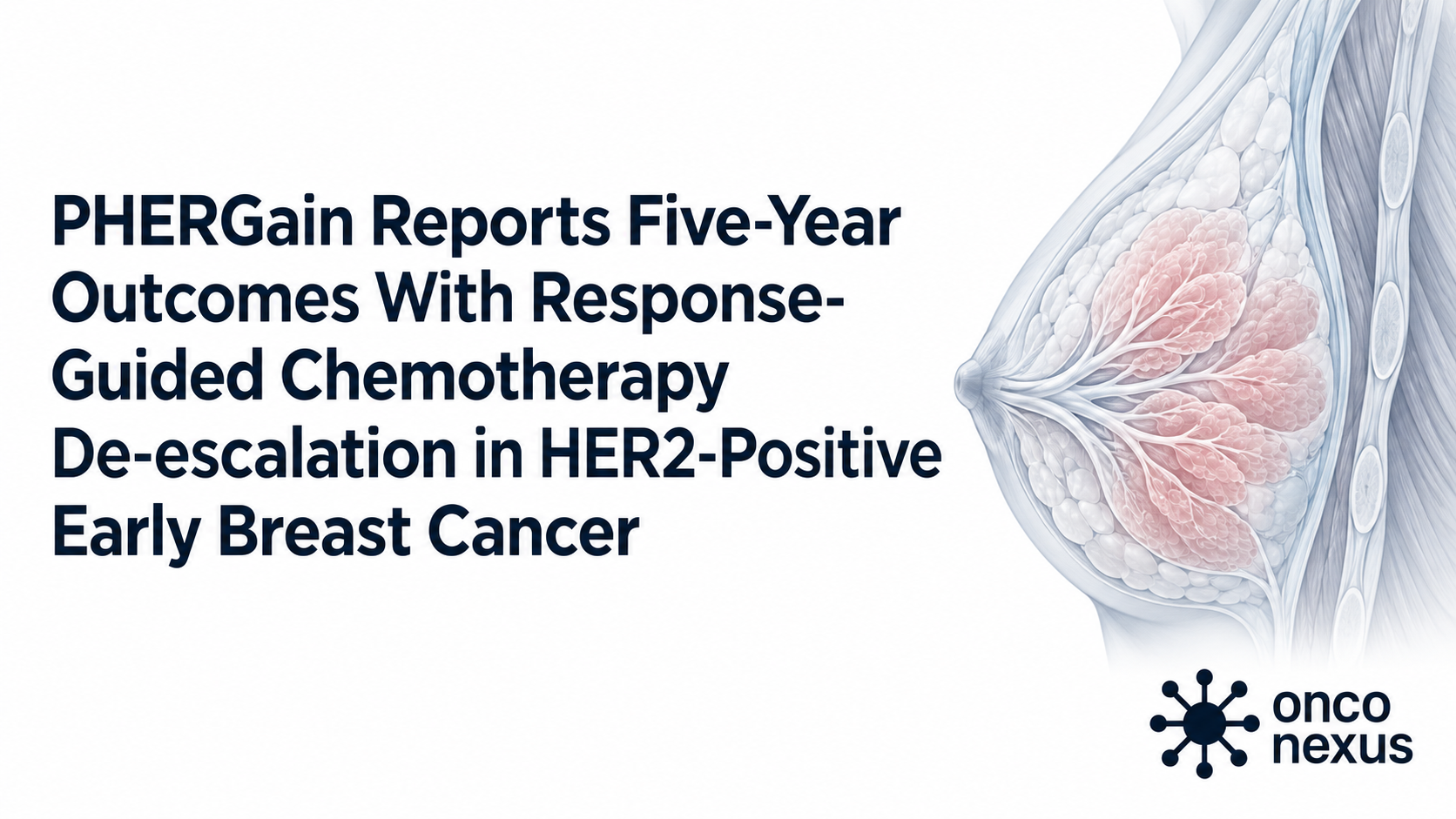
Five-year outcomes from the PHERGain trial, published in Nature Medicine, continue to support the feasibility of a positron emission tomography–guided, pathological complete response–adapted strategy to spare chemotherapy in selected patients with HER2-positive early breast cancer. The randomized, non-comparative phase 2 trial evaluated whether 18F-fluorodeoxyglucose-PET (18F-FDG-PET) response after two cycles of dual HER2 blockade with trastuzumab and pertuzumab could identify patients who could safely omit chemotherapy from their neoadjuvant regimen.
After a median follow-up of 5.6 years, the 5-year invasive disease-free survival (iDFS) was 89.5% (95% CI: 85.7–93.4) in the full adaptive treatment arm (group B; n = 267). Among the subset of 18F-FDG-PET responders who achieved pathological complete response without ever receiving chemotherapy (n = 86), 5-year iDFS reached 92.4% (95% CI: 86.7–98.5), with only one distant recurrence. The investigators caution that this latter estimate reflects a post-randomization subgroup defined by imaging response and pathological outcome, and should be interpreted as descriptive rather than as evidence of a causal effect of chemotherapy omission.
Key finding
In the PHERGain trial’s adaptive treatment arm, a 5-year iDFS of 89.5% was observed across all group B patients, and 92.4% among the subset of PET responders who achieved pathological complete response without chemotherapy — though the investigators emphasize this subgroup result is descriptive and cannot be interpreted as a causal estimate of the benefit of chemotherapy omission.
Study Design
| Trial | PHERGain (NCT03161353); randomized, non-comparative phase 2 |
|---|---|
| Population | Female patients with centrally confirmed HER2-positive, stages I–IIIA invasive operable breast cancer with tumor size ≥1.5 cm and at least one breast lesion evaluable by 18F-FDG-PET |
| Treatment | Group A (1:4 ratio): docetaxel, carboplatin, trastuzumab, and pertuzumab (standard). Group B: trastuzumab and pertuzumab ± endocrine therapy, with treatment adapted based on 18F-FDG-PET response after two cycles and pathological response at surgery; non-responders or those without pCR received docetaxel and carboplatin |
| Primary endpoints | Pathological complete response rate in 18F-FDG-PET responders in group B; 3-year invasive disease-free survival in group B |
| Key secondary endpoints | 5-year invasive disease-free survival (prespecified); circulating tumor DNA findings (exploratory) |
PHERGain was designed to test whether early metabolic response on 18F-FDG-PET could serve as a decision-making tool to guide chemotherapy de-escalation in the neoadjuvant setting, where pathological complete response is an established surrogate for long-term outcomes. Previously reported results showed that 37.9% of group B PET responders who continued without chemotherapy achieved a pCR at surgery, and that 3-year iDFS reached 94.3% across group B — results that underpinned the current 5-year analysis.
Results and Safety
At the 5-year mark, iDFS across the full group B adaptive arm was 89.5% (95% CI: 85.7–93.4). Within the descriptive subgroup of 18F-FDG-PET responders who reached pCR without chemotherapy (n = 86), 5-year iDFS was 92.4% (95% CI: 86.7–98.5), with only one distant recurrence reported. The authors explicitly note that this subgroup estimate, derived from patients selected by both imaging response and surgical pathology, should not be used to draw causal conclusions about the effect of chemotherapy omission.
The publication also reports exploratory circulating tumor DNA findings. Detectable ctDNA at baseline or during treatment was associated with inferior iDFS, while ctDNA clearance correlated with higher rates of pathological complete response and improved long-term outcomes. The investigators suggest these findings point to a potential role for ctDNA in further refining treatment individualization within this PET-guided framework, though no formal hypothesis testing of ctDNA-based endpoints was reported.
Detailed safety data for the 5-year follow-up period were not separately reported in the abstract; safety outcomes from earlier PHERGain analyses have been previously published.
Clinical Context
HER2-positive breast cancer accounts for approximately 15–20% of all breast cancer cases, and outcomes in this subtype have improved substantially since the introduction of HER2-targeted therapies. However, the standard neoadjuvant regimen — combining chemotherapy with dual HER2 blockade — carries a meaningful toxicity burden. PHERGain represents one of the more mature prospective datasets evaluating whether a biomarker-selected subset of patients can achieve durable disease control without chemotherapy, offering data that are relevant to clinicians counseling patients about treatment intensity.
Important questions remain. The non-comparative design of PHERGain means that direct efficacy comparisons between the adaptive and standard arms are not possible, and the chemotherapy-free subgroup result is explicitly descriptive. The investigators also note that recurrence patterns in HER2-positive disease differ by hormone receptor status — with hormone receptor-positive tumors carrying a risk of late relapse — underscoring the need for continued long-term follow-up. The emerging ctDNA data are hypothesis-generating and require prospective validation before informing clinical decision-making.
Sources
- Pérez-García JM, et al. 5-year outcomes of chemotherapy de-escalation in HER2-positive early breast cancer and exploratory circulating tumor DNA analyses from the randomized phase 2 PHERGain trial. Nature Medicine (2026). View source.